"We expect too much of boys-- and we don't expect enough... on the one hand, we expect them to do things they're developmentally not ready to do, and to be 'tough little men' when they are just little boys who need goodbye hugs and affection. On the other hand, when they behave in cruel and thoughtless ways, we say, 'Oh, boys will be boys.' We let them off the hook over issues of respect and consideration for others." From the book Raising Cain
This sentence has had me thinking over the past few days about balance. The concept is universal and applies to humans-- not just boys. How do we, as parents and teachers, respond to children in developmentally appropriate ways while also honoring the child by expecting them to meet their potential as brilliant, sensitive, creative human being?
We spend a lot of time at school thinking about these ideas. How do we make space for childhood to remain? For the work of play to remain? How do we challenge our students intellectually without giving in to 'the race to nowhere' that exhausts and stresses the children of our nation? How can we be in third grade but be deeply in third grade? Meanwhile, how do we support the child in being a contributing member of our community? How do we help to foster thought, consideration, compassion and empathy for the other humans with whom we spend our days and months and years?
When do we need to honor children by allowing them to be where they are and when do we need to honor children by expecting more?
Showing posts with label community. Show all posts
Showing posts with label community. Show all posts
Friday, November 16, 2012

Friday, October 5, 2012
3rd Grade Economics
This past week a parent contacted me to let me know that children were making and planning to sell homemade posters and wooden toys at school for money. We admired the initiative of the children starting these businesses but felt uncomfortable with the exchange of money at school. Was there a way to keep the interest alive with an alternative like play money? I gathered the class for a discussion.
K: We could make play money.
M: But if just anyone can make the money then it is pointless. I has no value.
G: Maybe we could have a mint that makes the official kind of money like our government does.
M: It just seems too easy to copy.
Me: I have access to a copy machine and more unusual colors of paper up in the office. It is paper that isn't just in all of the classrooms.
K: You could use the money from math. It looks really official.
R: We could just pay in things like rocks and sticks like we did last year in the garden.
Me: I remember that. Is it going to be a problem that you are out on the field now? There aren't as many rocks and sticks out there.
M: That is even better because they will be more valuable.
H: If we use the money, how will it get out into the world?
F: We could just have a bank. You could go get money at the bank.
H: In the real world you don't just get free money.
Me: If I go to the bank to get money I would have already had to put that money in the bank earlier. They just hold it for me. Maybe you could all start earning it by doing extra jobs around school.
M: I would rather just trade natural resources. Rocks are much more valuable to me than fake money.
R: But if you do natural resources, what is the work you have to do for that?
H: You would have to go mine it out of the ground.
Me: Right, you spend your precious time and energy gathering those things and people are willing to trade or pay you for it because they don't want to spend their own time doing the work.
The conversation went on and on. The children thought about trading product for product. Or natural resource for resource. Could they set up a trading post? What jobs could they do? How would we make the money earning opportunities even?
We voted on a currency. The children chose natural resources. One student asked, "I still like the idea of money, I just liked natural resources better. Can we just do all of them?" We decided no to limit ourselves to just one form of currency.
That very day during Spanish I got busy printing official money. By lunch the children were harvesting resources, making trades, forming business partnerships and making plans for their future fortunes.
Through out this process I am thankful to be in an environment where I have permission to slow down and give time to the things that are important to the children. Not an hour passes without me hearing whispered business plans. And never have the children so eager to pick up trash from the far corners of the playground.
K: We could make play money.
M: But if just anyone can make the money then it is pointless. I has no value.
G: Maybe we could have a mint that makes the official kind of money like our government does.
M: It just seems too easy to copy.
Me: I have access to a copy machine and more unusual colors of paper up in the office. It is paper that isn't just in all of the classrooms.
K: You could use the money from math. It looks really official.
R: We could just pay in things like rocks and sticks like we did last year in the garden.
Me: I remember that. Is it going to be a problem that you are out on the field now? There aren't as many rocks and sticks out there.
M: That is even better because they will be more valuable.
H: If we use the money, how will it get out into the world?
F: We could just have a bank. You could go get money at the bank.
H: In the real world you don't just get free money.
Me: If I go to the bank to get money I would have already had to put that money in the bank earlier. They just hold it for me. Maybe you could all start earning it by doing extra jobs around school.
M: I would rather just trade natural resources. Rocks are much more valuable to me than fake money.
R: But if you do natural resources, what is the work you have to do for that?
H: You would have to go mine it out of the ground.
Me: Right, you spend your precious time and energy gathering those things and people are willing to trade or pay you for it because they don't want to spend their own time doing the work.
The conversation went on and on. The children thought about trading product for product. Or natural resource for resource. Could they set up a trading post? What jobs could they do? How would we make the money earning opportunities even?
We voted on a currency. The children chose natural resources. One student asked, "I still like the idea of money, I just liked natural resources better. Can we just do all of them?" We decided no to limit ourselves to just one form of currency.
That very day during Spanish I got busy printing official money. By lunch the children were harvesting resources, making trades, forming business partnerships and making plans for their future fortunes.
 |
| A stick with more unusual characteristics may be more valuable. |
 |
| Harvesting rocks to sell to rock smashers for money. |
 |
| Money is kept in the watchful care of bankers while work is done during recess. |
 |
| Smashing rocks makes them more valuable. |
 |
| "Is crushed rock more valuable than a whole rock?" "Yes, especially if you can get a piece that is just pure crystal." |
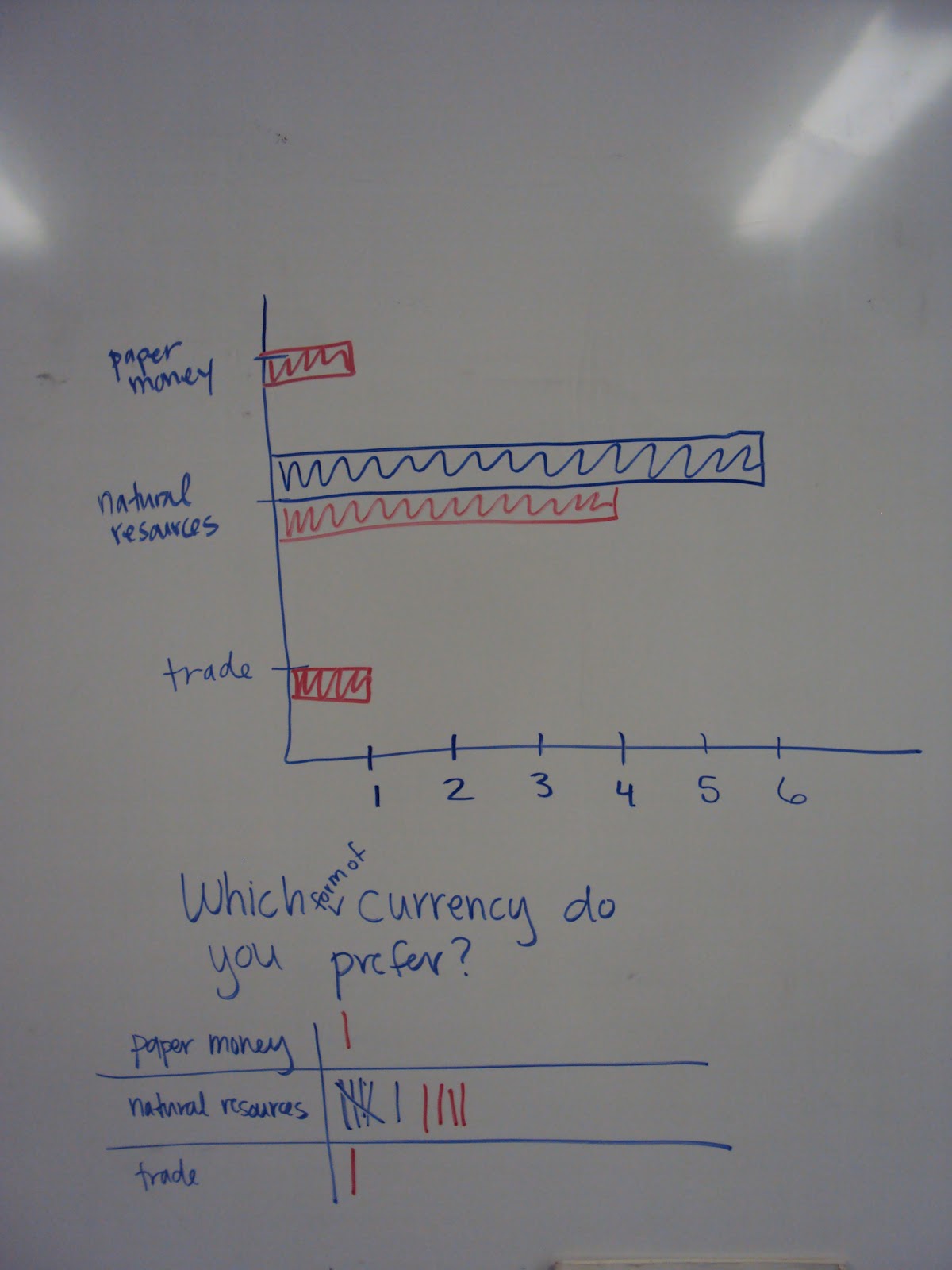 |
| The game allows us to substitute more authentic questions into our math unit on data analysis. |
Friday, September 21, 2012
Community Games

Plans for games about good communities are underway.

The children are working to develop games that can be played in class to
remind us of the type of strong community we would like to be.

I am very interested in seeing these games develop.
What will they feel is important?
How will this work help them to further process their ideas?

Appreciation

We started a tradition today. Each Friday we will begin our day with sharing an "appreciation" for one of our class members. We are trying to think beyond our immediate friendships to people we might not usually get a chance to compliment. We are looking for acts during the week that help our class to be a better community. My intention for this tradition is to help us notice the kind things that happen in class. I also think that it is a time that we see our ideas and values in action in the small acts of each day.
"I appreciate you because you gave me lost of good feedback on my ideas."
"He always helps clean up."
"He apologized after he the soccer ball he kicked hit me in the face."
"You are great at listening at circle. You raise your and and listen quietly when others are talking."
"I appreciate that he apologized to the whole class after his silly day on Wednesday."
"I like how he always makes peace and doesn't want to fight."
"I appreciate that he always gives people comments and that helps other people give other people comments and it makes our class a better place to be."
"She contributes helpful ideas to our class."
"You help our community stay on topic."
"You do a great job at paying attention and for that I say thank you!"
Wednesday, September 5, 2012
Who am I?
| Who are you? You are a small piece of the community, but a very important piece. What strengths do you bring? What talents will you contribute?  |
| "Why do your eyes look like that?" "Because I am quiet but I am always watching." |
 |
| "My mask has a cloud dragon putting out fire with rain. It is from the Japanese ledgend. It means I am a peace maker." |
 |
| "Girls can be tough." |
Tuesday, May 22, 2012
Our Side of the Story
Here is our side of the "friendly sign" story

The children started to notice signs all over campus.

We found ourselves huddled around them with other classes
wondering what the signs were and where they came from.

We couldn't help but feel happy and more friendly as we read the signs.

Our afternoon did not go as planned. We left our plan to live in the moment.
We chased around campus on a treasure hunt to find all of the signs.


The element of surprise had a feeling very cheerful indeed.
Subscribe to:
Posts (Atom)