Monday, February 25, 2013

How to be a Scientist

"How do scientist learn about the world around them?" The third grade wrote this guidebook to share their insights on the process of learning like a scientist. The content is completely from the children. They developed the headings and the explanations. It is a bit long, but even just by scanning through the headings, one can see the depth of understanding the children are developing about how to think like a scientist. In the end, my goal was not for them to learn everything there is to know about shadows (however, they did learn a lot). In the end, I wanted them to learn how to learn.


How to be a

 Scientist

Written by 3rd Grade

2012-2013

Sabot at Stony Point
 
   
Using Our Senses To Observe
Sometimes when using our senses, we can’t focus on multiple senses at once. Try focusing on any two, three four or five senses and see if you can make sense of them.

 
How Scientists Use Their Senses
Scientists use their senses to observe the world around them. Astronomers use sight for stargazing. Chemists use taste if their designing a food.
As scientists, we used these same skills. We used our sense of smell to observe this liquid. We used touch to feel this charcoal. We used sight to observe shadows.
 
 
Observe Over A Period Of Time
Every Friday our class goes into the forest to observe the creek. Observing over a period of time is important because if you just look at something once, then you don’t have believable data. We record our data in the class binder so that we can compare it to the other days we measure. We see if it is similar or different.

Making Connections
Making connections is an important part of science. Making a connection is very simple. You just have to relate one thing that happened to you in the past to something that is happening in the present. You also have to use your brain to figure things out. For example, when we were studying shadows, we related a flashlight to the sun because we were holding it up like it was the sun. We used what we learned from this model to connect and learn more about the sun.
 
Scientists Do Things More Than Once
Scientists check something more than once because they want to be accurate. For example: Let’s say that you are measuring the depth of the creek and you measure it once and you get 17 cm.  You went back again and got 15 cm. The reason that is, is because the creek is not always going to be the same measurement because the creek always changes.
Scientists also do things more than once because you want to make sure you are accurate. For example, when I go down to the creek, I always measure in different places to find the deepest place. If I just measured once, it would be like the creek was always one depth.
 
Try, Try Again
Scientists try, try again to prove theories. If their theories aren’t right they try again. For example, when we were studying shadows, we kept trying to see if shadows disappeared at noon. We went out every day at noon to see what happened. Our answer was that they do not disappear. People had to change their mind about what they thought.


Measure
Measuring is very important in science for tests and experiments. Measuring is important because you use it in different varieties of science and without measuring it would be hard to get believable results. With measuring, it is easier to compare.

The depth group is measuring the depth of the water in the creek.
 
Be Willing to Change Your Mind Based on What You Observe
When you are doing and experiment and you have a hypothesis, maybe you have a different hypothesis than other people and then you do a test and you find out that your theory is wrong you should be willing to change your mind for example: when our class had a theory that shadows disappear at noon. We went to experiment and some people were wrong. They were willing to change their mind based on what they observed.


Learn From Your Mistakes
Sometimes people have a different hypothesis than others and they go outside and realize they're wrong but then, all of the sudden, the person realizes that he learned something from his mistake. Example: When a person in our class had a hypothesis of a single light causing multiple shadows but then we tested and his theory was wrong but we learned that a single light causes a single shadow.
Make a Guess/ Develop Hypotheses
A hypothesis is a question or a theory that you think is going to be true or happen. It may be right or it may be wrong. How do scientists make or develop hypotheses? Well once we were talking and somebody said, “Look that shadow has multiple shadows!” Then someone said, “That is because even one light can make multiple shadows!” So our teacher said, “Let’s test it!” When we went outside the {hypothesis} was not true. That is how scientists make a guess and find a theory in it.


Use Models to Learn About Other Things
Scientists use models to help them learn about the world around them.  We use models because if we don’t use models they would have to travel around the world and possibly to the sun or moon. The Earth and the sun are too big. We can’t change what the Earth or sun is doing. With models, we can make them turn different ways and we can put them at angles. With the real Earth, that would be hard. We can also make things happen faster than on the real earth.

In this picture we have made a model of earth and the sun to show
how scientists learn about the world around them.

Think Outside the Box
Scientists think outside of the box because it is useful. Thinking outside the box is when you just don’t think normally. For example, that is how multiplication was invented. Thinking outside the box is a wacky form of creativity. You can come up with new ideas.
Consistency
Be consistent. Don’t change what you are doing. For example, we measure water temperature, water depth and pH each Friday in the same way using the same instruments. If you were not consistent, you would not get correct measurements and probably get untrustworthy results.
Record Your Results
Recording is very important because if you don’t you might forget your measurement and think it is something else. Like when one of the 3rd grade students who was in the depth group was measuring and she forgot it so she made and estimate of a higher water level.
Don’t Rush
Don’t rush it doesn’t help at all, you might get the wrong measurement if you rush your experiment. Like when a girl in the temperature group she just stuck the thermometer in the ground and took it out soon after. Later they learned that it takes about 4 minutes to change to the correct temperature.
 
Don’t Jump to Conclusions
Check multiple times until you are certain. Don’t jump to conclusions. Voting is not a conclusion. Experimenting to find out is a more reliable conclusion. For example, if a scientist were to jump to conclusions, they might not be correct and that would throw the whole experiment off.

Thursday, February 21, 2013

Noon Shadows


Noon Shadows from Andrea Pierotti on Vimeo.

I was looking through some old video footage from our shadow investigation. The work went on over a few months. We had many conversations, observed outside day after day, built models, and used an indoor light labratory to try to answer the question, "Do shadows disappear at noon?" Enjoy a small glimps into the process.

Monday, February 18, 2013

Integration


I am excited for the next few months. Reading, writing, history, math and our focus on community are all starting to collide. We are always trying to integrate. We look for connections between all that we do, but this time it is all coming together so seamlessly. Here is a little peek.


What types of challenges do the characters face in the books we read?
We read aloud the book The Search For Delicious by Natalie Babbitt.
We looked for the challenges the main character faced.
What did he learn from his experience and how can we apply that lesson to our lives?

How did the characters learn and change from these challenges?

What can we learn about life from watching the journey of our characters?

We began to look for the conflicts that drove the story in all of the books we read.
Every book containing a story has also contained a conflict of some kind.
We keep adding to our chart.


Where do authors get their ideas for the challenges they give to their characters?

Challenges seem to get worse before they get better, so how do authors build the tension of the challenge before it gets resolved?

 
We researched the work of published authors.
We read and mapped out the story of picture books on a
"story mountain" to help us identify the story arch.


Who will be our characters in the stories we write?
What challenges will they face?

Thinking about their own writing, the children began to develop fictional characters.
What are their inner characteristics as well as their outer?
We know that in each of our stories, the characters will need to face challenges.

Are there challenges you have faced (or seen others face) that you could give to your characters?


·         Scared of the dark

·         bullies

·         wanting to fit in

·         never getting to do things because you are the youngest

·         not wanting a lot of attention

·         being scared to do something on your own

·         peer pressure

·         not wanting lots of attention

·         a brother who teases

·         always being late

·         not knowing how to write fiction

·         stage fright

·         words always coming out the wrong way

As authors, the children began to plan out their own fictional writing on a story mountain.
They gave careful thought to how the story would build over time before being resolved.
 

How can listening to others for understanding and empathy help us resolve conflicts within our own community?

 
We have been thinking about these Habits of Mind.
We have talked about persistence and controlling impulses.
Our current focus is on listening to others with understanding and empathy.
We are finding that it is a skill we can use to become better
at just about everything (including math, reading and writing)
 

How can listening to the characters for understanding and empathy make us better readers?
"If I were Jessie, I would be feeling both excited and scared. I would be really scared and sad to leave without Grandmother, but this was a once in a lifetime opportunity."

How can listening to our fictional characters for understanding and empathy help us figure out what to write when we get stuck?
 
One student came for a conference about her fiction writing. "I am coming to the most important scene in my whole story and I don't know what to write because I've never had this happen to me before." We decided that this was a time to practice empathy, even if her character was not real. She closed her eyes and imagined herself in the character's exact situation. What thoughts would she have? What emotions would she be feeling? What would her body be doing? What would she see or hear? The student went back to her seat to translate her moment in her character's shoes into action and setting and dialogue.


How does listening to stories of the past for understanding and empathy help us understand the people of the past?

We are beginning to fill our time with historical fiction and non-fiction books about immigration.
We read with empathy, imagining what it might feel like to be those characters.


We are making a timeline. We will use it to begin to develop a sense of history.
It gets us to do lots of calculating. If every year is a half inch, how long would your life be on this number line?
If someone was born in 1836 and came to America in 1903, how old were they when they arrived?


What was it like to immigrate to America? What challenges did our ancestors face?

We are beginning to hear stories of the ancestors of class members.
There stories bring the past to life.
This was not just some random person a long time ago, it was Cameron's ancestor!

Could the challenges of the past be the inspiration for our next fiction stories?

We hear about how our ancestors traveled to America, why they chose to
come and what their hopes were for future generations.
 
 
Can our ancestors inspire our next characters?

As we look over records of our ancestors I began to wonder if we could use what we find in
 our history investigation to inspire us to write historical fiction.
We have character profiles just staring at us from the pages of history.
What an exciting way to connect to our own people.

Friday, February 1, 2013

Ellis "Treasure" Island

As part of our history investigation, the children have been looking at documents trying to find clues to unlock the mystery of this time in American history. They had noticed big patterns:
  • People moving
  • Sailing in ships across the Atlantic
  • Steam ships
  • Often going to Ellis Island
  • Dates in the early 1900's
Questions arose:
  • Who were these people?
  • Where were they going?
  • Why were they traveling?
  • Where is Ellis Island and what does it have to do with immigration?
  • Why do these documents always talk about aliens?

While the children were discussing their ideas about the historical scenario in question, one child said, "I wonder why they were traveling to Ellis Island. I mean why did they even care? Did Ellis Island have a treasure?"

Sometimes when I hear unexpected comments like this, my initial reaction (in my own mind, of course) is to kind of surprise. "Isn't that cute. They think there is treasure on Ellis Island." And then dismiss the idea all together because I know the travelers weren't hunting for burried pirate's treasure.

Over time, I've been practicing suspending judgement. I'm trying not to react to the idea and theories of children until I have a better understanding. In making an effort to listen, I have to pause and ask a follow up question. I'm not perfect at it yet, but more often than not I am completely blown away by the thinking behind some of the statements I initially do not understand.

"Tell me more about that."

"Well you know how the early settlers of Jamestown came because they thought there was gold? I wonder if these people thought there was some sort of treasure too and that it was buried on Ellis Island."

What a valid point. Hadn't there been rumors of gold influencing the settlers of Jamestown? Hadn't there been large migrations to the west coast because of the gold rush? Seeking treasure was a very real motivator throughout history.What I was tempted to view as a simple child's view of pirates and treasure was actually a profound connection to this child's previous knowledge of history. The class had spent their time as second graders completely immersed in the study of the early Virginian settlers of Jamestown. Come to think of it, weren't many of those immigrants in search of a treasure of sorts?

Not only did this child's idea make sense in context, it was a pretty brilliant idea. Yes, they were traveling to Ellis Island for treasure. The next question is what was that treasure.

Seeking the context of thoughts allows me to spot gems that I would have otherwise completely overlooked.

Monday, January 28, 2013

Community Street: How to Help Edit


How To Help Edit from Andrea Pierotti on Vimeo.

This skit was developed and edited by these two third graders. This is their advice about how to edit in a supportive way. Stay tuned for more small episodes developed by the other children in the class. This is our work for an hour each Friday when we revisit the topic of being a caring community.

Wednesday, January 23, 2013

Forest Research


Forest Research from Andrea Pierotti on Vimeo.

Take a peek at our time in the forest on Fridays. I can already see them talking spontaneously about the changes they are observing. I'm excited for the representations of their data. Which things changed the most? Which did not change much at all? Why?

First Snowfall

Measuring the depth on our snowboard

Core sample

Melting the snow and measuring the mass
to find out how wet the snow was

Monday, January 21, 2013

MLK Day: A Day of Community Service

Children from many grades kicking off our
Togetherness Project with Anna in Founders Hall
 
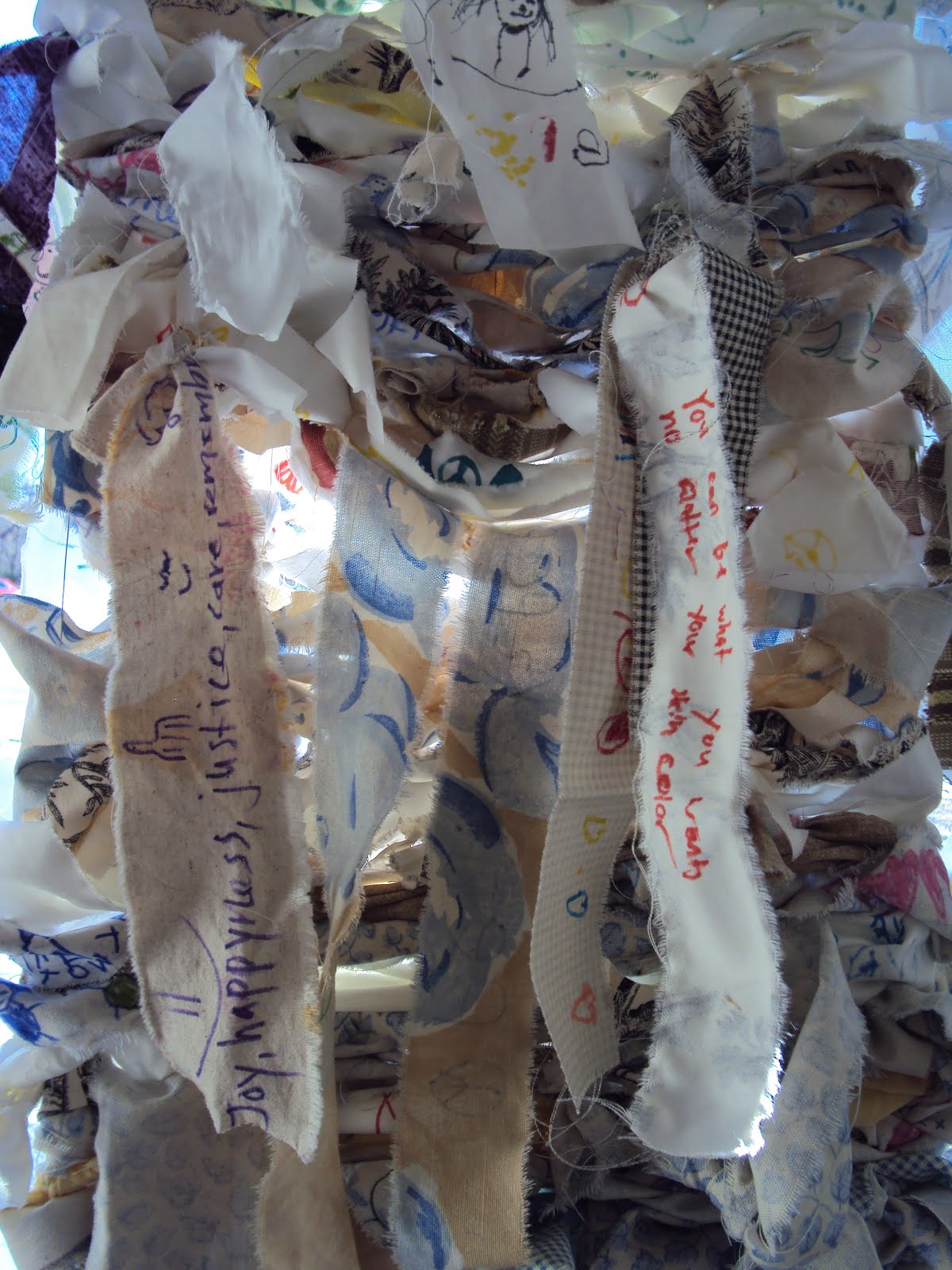
Writing messages of togetherness.
 
Weaving the messages together as a symbol of our hopes for the future.
 
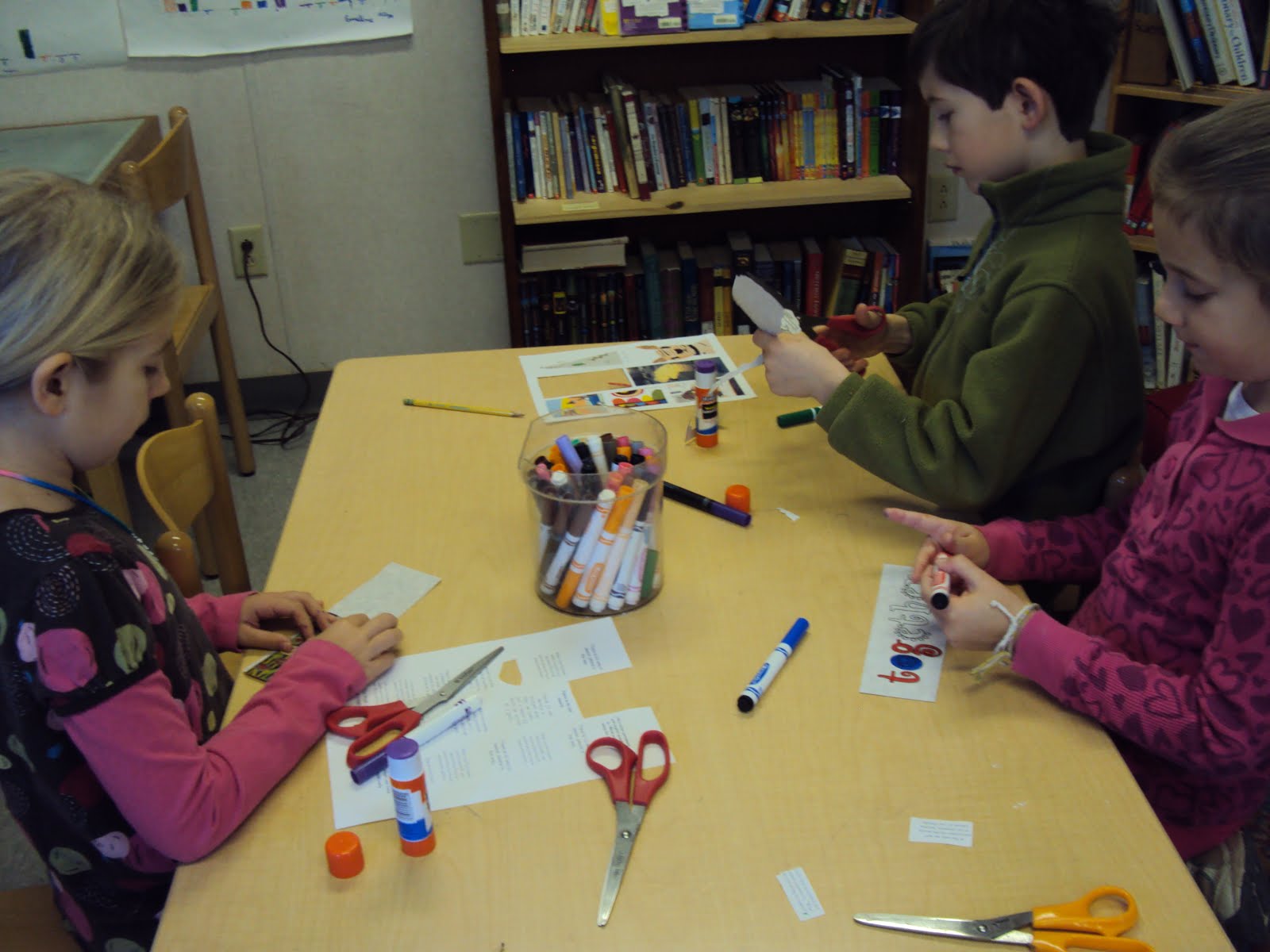
Making bookmarks to accompany the books we donated to children in need.
We filled our designs with messages of love and hope. Some people even used the words of Dr. King
 
Cooperative games with the 4th and 5th grade and Renee.


We did a kindness project with 4th grade that involved some "guerrilla goodness."
Check out the project here (you may find other fun ideas to spread kindness at home).
We also snuck around campus leaving similar messages for the people around us to find. Sneaking around is fun!


We finished off the day with a circle.
We shared our ideas about the important changes Dr. King brought about, sang songs of hope and listened to Dr. Carney read some of the famous "I have a dream..." speech.

It was a great day to put all of our attention towards doing good,
 being kind, fighting for the changes we want to see in the world around us.
As I watched the kindness of these children I couldn't help but think
 that the future looks very bright!

Saturday, January 19, 2013

Historians Hunt For Clues

Inspired by the book Ain't Nothing but a Man: My Quest to find the Real John Henry by Scott Reynolds Nelson, our class has started to investigate how to be historians.We are following Nelson through his journey, paying close attention to how he finds his way through his research. We notice the types of documents he looks at, where he gets new information and the type of thinking he does to piece it all together. And to add to the excitement, Richmond is a key place in his research.

Ain't Nothing but a Man: My Quest to Find the Real John Henry   


To put our new understandings of the work of historians to practice, the children look over copies of documents from a certain time period in American history. The period remains a mystery. The children are looking for any information that will help them to identify the time and significant events. They are also trying to figure out what life was like for the people contained in these documents. But first, we need to figure out what the documents are. 

"Why does this one say the same words over an over?"

"I think these typed parts at the top are the question and these words are the answers"

"This has a date of 16/9/25! There is no 16th month!"

"This cursive is hard to read."

"I think this one is from someone who is going to Italy."

"No, I think it is the other way around. Someone is leaving Italy and coming to America."
 

"These names are weird, Carr William?"

"I think they are listing them with the last name first."

"These two were probably married because, look, 
they have the same last name."
"I think these strange letters are a different language."


Friday, January 11, 2013

Community Street: Dealing with Insincere Compliments


Community Street: Insincere Compliments from Andrea Pierotti on Vimeo.

Self-Assessment

 
We used rubrics for the first time this year. The children worked with a partner to assess their personal narratives. They evaluated their mechanics, their use of narrative language and their planning. I was surprised by how accurate the children were and how honestly they identified their strengths and areas to improve.

Glass

Local glass artist, Ryan Gothrup, came to Sabot to demonstrate his craft. His visit was funded by a grant through the VMFA that promotes exposing children to the arts. We enjoyed a 45 minute demonstration. The children were full of curiosity. Thanks to Kerry and Pippin for making this happen.


Monday, December 10, 2012

Community Street

Every Friday we set aside an hour of our time to revisit our work with communities and relationship. We continue to work with our studio teacher, Anna, on our community sculpture, so half of the class goes to visit with her. The children are creating symbols of strong communities out of clay.


The rest of the children remain in class. We were using the time to develop board games that helped reinforce ideas about good communities. The games are finished. I was thinking about how to fill the time in class in a meaningful way.

One Friday morning after playing math games, children were discussing who had won. In a spontaneous way we ended up singing a funny little song about how it is OK to have a winner and that it is just not a big deal. One idea lead to another and we eventually ended up with our own show called Community Street, which is patterned after Sesame Street with small little episodes meant to be instructive to the viewer.


Community Street: No Big Deal from Andrea Pierotti on Vimeo.


I decided that I wanted the show to address real problems that the children face on a daily basis. We now have a  jar in which we collect difficult social situations from the children's lives. The second week we had a scenario written. "My sister and I sometimes fight over what to play." We used that as our focus for our skit about compromise.


Community Street: Compromise from Andrea Pierotti on Vimeo.

I'm interested in what other topics will emerge. How will processing these topics in this way assist them in dealing with future social encounters?

Friday, December 7, 2012

Weather Station

Mr. Jones came and helped us set up an official class C weather station (at least I think that's what he said). We will be measuring the precipitation at Sabot for an entire year. Our measurements will be passed along to meteorologists to help them with their work.
 This is a snowboard. It allows us to catch and measure the snowfall off of the ground so that the temperature of the ground does not interfere with our data. Mr. Jones thinks there are only three in Richmond. There is the official one at the airport, one at his house and now one here on campus. We want our data to be as accurate as possible. We will measure the depth, but will also capture a cylindrical sample and melt it to measure the water content of the snow. We sure hope is snows SOON!!
 This rain gauge will help us measure the rain fall.
We will also measure the temperature twice a day every day at the same times.

This is exactly the kind of authentic work I would love to always have for my students but don't always know where to find. Luckily he found us!