We went over to the middle school to check out the trout tank for the first time. We will be back soon because the eggs are supposed to hatch!
http://mssciencessp.blogspot.com/2013/10/the-trout-eggs-have-arrived-they-are-so.html#comment-form
"No offense to the trout, but they look like what I imagine a germ to look like!"
"I was surprised how SMALL they were!"
"They looked like eyeballs."
"I did not think there were going to be THAT many eggs."
"I thought there were going to be MORE!"
"More than 200!?!"
"They were really cute! But I felt really bad for the rotting ones."
"Me too. But at least in the tank they have a much better survival rate."
"If our eggs match the usual results, we should have about .... 50 eggs hatch!"
"I want to see them hatch!"
"What will the actual survival rate be? Will it be more than 50? Less than 50?"
"I hope the non-fungus eggs survive. I hope no more get fungus."
"Once you get fungus, can you get rid of it? Is there medicine?"
Monday, October 7, 2013

Wednesday, September 25, 2013
Life Lessons From The Game
Playing “The Game” is not really about the game at all. It
has been about thinking about how to interact and communicate when we are at
odds with each other. How do you get along in the heat of the moment? How do we
deal with disappointment? We stopped often along the way to uncover the life
lessons we felt were being learning in our game playing. “What have you learned
by playing the game that might actually help you in real life?”
The class discussions were full of gems of advice. Here are
some highlights.
Dylan: It is possible to see good in something you thought
was bad. For example, if you get a lot of the same card over and over it seems
bad. But then if you see, it can also be good because you can trade those cards
to get what you want.
Lila: You have to stay kind about it and you have to stay
calm. You can’t be like, “HEY!!! WHY DID YOU DOOO THAT TO US!!!” and stay calm
and be happy about it because maybe there will be some good to come out of it
like Dylan said.
Mallory: You have to deal with bad things happening. Like if
someone puts the robber on you, you just have to deal with it and not get
really upset about it.
Sam: You should always remember the golden rule, especially
the part that says that you should treat other people they way you want to be
treated. So if you rob someone by the robber, you can either rub it under their
noses and if you want someone to do that to you, well of course, keep doing it!
But if you want people to say, “I’m sorry, it is not personal. We were just
wanting to slow you down because you were in the lead!” That is OK because
usually you would want someone to teat you like that.
If you’d like to read the whole
conversation (my colleagues and I found it fascinating) I’ll include the
transcript at the end.
Not long after these discussions, I found the ideas
contained within them guiding my own life.
My family just recently bought our first house, so naturally
is needs a bit of TLC. My husband had been working hard to spruce the place up
before we move. He had been sanding the floors one day. He left the house and
returned in a few hours to find the back door kicked in and the power cords cut
and stolen from all of his sanders and power tools along with our fridge, stove
and AC units. Talk about feeling deflated. “This is JUST what we need!” I
thought to myself sarcastically as I drove home after hearing the news. As I
sat evaluating my feelings, I began to hear the voices of my third graders ring
in my memory.
“You have to deal with bad things happening. Like if someone
puts the robber on you, you just have to deal with it and not get really upset
about it.” I had a choice. I could either let this totally get me down and into
a pity party or I could just acknowledge that I didn’t like what had happened
and move on. Getting super upset wasn’t going to change the events; they had
already passed. (And how funny was it that the context of disappointment in the
game had also been a robber. Ha!)
“Don’t take it personally!” Did the thief know us? No. They
were obviously desperate from whatever circumstances they were facing in their
own life. They weren’t against me
personally.
“Stay calm and be happy because maybe some good will come
out of it!” With an insurance claim we will likely be able to replace most of
our stuff. It just might be how we afford a new fridge which we needed anyway. (OK, so that one didn't really end up working out, but it was a comforting thought in the moment. I'll keep a look out for other possible silver linings. )
The words of the children were empowering. Their ideas
totally changed my outlook. It was one of those moments that teachers have from
time to time where my eyes brimmed with tears as I reflected on what a privilege
it is to work with children. They have a way of grounding me and continually
bring fresh perspective to my eyes. Their advice was there to guide me just
when I needed it.
The lessons we learned from the game really are lessons for
life far beyond the classroom—lessons for their lives … and for mine.
____________________________________________________________________________
The following is a transcript of some of our conversations about the lessons the children learned while playing the game.
Teacher: “What lessons are we learning from the game?”
Jude: We need to work well with other people in life and we
have to do that in the game.
Teacher: You all decided that the team that won the first
game was so successful because of how well they worked together and how well
they listened to each other.
Mallory: You have to deal with bad things happening. Like if
someone puts the robber on you, you just have to deal with it and not get
really upset about it.
Stella: You have to take care of your resources.
Dylan: You have to communicate clearly. It is also possible
to see good in something you thought was bad. For example, if you get a lot of the
same card over and over it seems bad. But then if you see, it can also be good
because you can trade those cards to get what you want.
Lila: You need to save your resources for the things you
really want. Don’t just spend them on little things you don’t care about. Save
up to get the important things you really want. Also, sometimes you need to
spend you resources before you lose them. It is better to spend them while you
have them than to lose them and not get to spend them at all.
Sam: I learned that you should… if you put the robber on
someone, then later they only have one resource left and they want to trade with
you, that is one way to mend the relationship. But if you say no, that might
make the relationship issue even bigger.
Teacher: Once a relationship has been hurt, you can mend it
or make it worse depending on the decision you make after that. Do you think
that could apply to real life, like with a friendship? You hurt someone’s
feelings and you can either make things better or worse with what you choose to
do next?
Class: Yes!
Mallory: You have to choose to be flexible. Like if two
people on your team want to build a road and you don’t want to, you have to be
flexible and just be like, “Well… Ok…”
Teacher: It wasn’t what I wanted, but OK. In real life do you always get things that
way you want it?
Lila: Like in voting for president. Maybe the person you
voted for doesn’t get elected.
Stella: I’ll have to live with it for four more years.
Dylan: I don’t exactly know how to say it, but like when we
disagreed about who’s turn it was to roll and I just let Arthur have the dice…
Teacher: Hmmm…. how would we put that. Maybe being generous?
What happens when you are generous?
Lila: You get generosity back.
Tally: You get respect back.
Lila: Don’t let people know what you have. Like if you tell
people in the real world how much money you have, they might come and steal it
from you. But also in the game you shouldn’t tell people what you have.
Teacher: So that sounds kind of like "keep personal
information personal." Like I just bought a house and was so excited to tell my
friends and family on facebook, but I realized that I shouldn’t put my address
out all over the internet, so I just had to say, “I bought a house!”
Sam: I want to add on about the generosity. You should
always remember the golden rule, especially the part that says that you should
treat other people they way you want to be treated. So if you rob someone by
the robber, you can either rub it under their noses and if you want someone to
do that to you, well of course, keep doing it! But if you want people to say,
“I’m sorry, it is not personal. We were just wanting to slow you down because
you were in the lead!” That is OK because usually you would want someone to
treat you like that.
Teacher: There was also a lot of talk about the golden rule
around development cards. If you want every other team to throw a huge party in
your face whenever they get something good then you can do that. But if you
don’t want people to do that, then you shouldn’t really do that.
Sophia: Me and my team, when we get development cards we
need we try to like just act normal and
not be all “Yeah!!” and try not to be in everyone’s face, but inside we are
happy.
Teacher: Good point. It is OK for you to feel happy about it.
It is just about not rubbing it in other people’s faces. Any other ideas?
no answers….
Teacher: I wrote down a few I noticed going on in the game.
I wrote “It’s not personal!” Did you see people moving the robber on people or
blocked them or tried to foil their plans in some way in the game just because
they don’t like THAT person? Or was it more because, “Hmmm I really need to
slow that team down and this is just want I need to do for my team.”
Mallory: Like when my team built a road in the way of yours.
You were just like… Well it had to happen.
Sophia: I was just like, “Oh, darn!”
Teacher: You can either get super upset or just think “Oh,
darn!” Don’t take it personally. They weren’t personally trying to make Stella
mad by doing that, they just needed to do that for the game. Another one I had
written was what about when your plans don’t work out? I keep hearing from the
same people. I’d like to hear from others.
Tally: To be flexible.
Like just say, “This isn’t what I wanted mom, but I’m just going to go
with it.” [She goes on to tell about plans she wanted for a play date with a
friend she doesn’t often see but her mom has other plans]
Teacher: So it wasn’t your plan, but you are just going with
it anyway. That happens in the game a lot too.
Lila: You have to stay kind about it and you have to stay
calm. You can’t be like, “HEY!!! WHY DID YOU DOOO THAT TO US!!!” and stay calm
and be happy about it because maybe there will be some good to come out of it
like Dylan said.
Sam: When you make a mistake or when you plan is ruined, you
probably need to say, “This wasn’t my plan but you guys needed to do that so…
or wanted to do that, so….” And maybe there might be a good thing in that
mistake. Like say someone put the robber on you and it was on wheat which you
really needed and then you could say, “OK, I didn’t want that to happen, but I’m just going to have to
be flexible”
Teacher: Is it OK to feel bummed about it?
Class: Yes.
Teacher: Sure… you just don’t want to let it shut you down.
Sam: But then you also realized that you had too many cards
and if you had gotten that card, you would have had to put half of your
resources back. The bad things actually turned into a good thing and saved you
from losing a bunch of cards.
Tally: Putting the robber on you is kind of like a
compliment..
Teacher: How so?
Tally: They want to slow you down because you are doing so
good.
Arthur: So that’s a compliment? Cool!
Lila: Are you just going to put the robber on yourself then.
Arthur: Yep.
Lila: Then you get to rob yourself.
Arthur: Hands up, self!
Teacher: I also have written down “Including Everyone” so
how is that happening in the game and how would that relate to real life?
Mallory: In real life, if you didn’t include everyone in an
important business meeting, then something could go terribly wrong.
Stella: Like I was reading this book about how the gods were
making the world but they didn’t want to work with one lady and they forgot
things and the world didn’t work out.
Teacher: Have you ever noticed that sometimes during the
game there are two people talking and the third person is kind of left out, but
then when you’ve invited them in they actually had really good ideas that you would
have missed if you never asked them.
Lila: And you could have won!
Tally: In the beginning we were trying to include everyone
but we really weren’t trying enough.
Lila: Three brains are better than two.
Dylan: You can get more reasons.
Teacher: I remember seeing a time in the game when on one
team two people were very sure that the decision they were about to make was
the best decision and because they had two they could outvote the third person.
But I remember that when that third person came and explained why it was a
reason that the other two had not considered at all. I could see in their
team’s eyes this look of [gasp] “You’re right! I had never considered!” and it
totally changed the whole teams mind and they changed their whole plan. What if
they hadn’t listened to their teammate and the bad things happened to their
team?
Mallory: I saw that happen on the red team too. Dylan wasn’t
really talking and was kind of off to
the side and then they came into the conversation like, “Noooooo!”
Teacher: And she was able to present a reason that they team
hadn’t considered before?
Mallory: Yeah.
Teacher: Have you ever been the person that hasn’t been
included? How does it feel?
Arthur: Bad
Mallory: Once I was the person left out and I couldn’t
really hear what they were saying but they were making plans to like build a
road or something. I was like, “WHAT are you DOING?” I just felt like it was my
team and I had a right to know what was going on.
Teacher: Mallory wrote down a bit of advice, “Don’t Brag.” I
keep hearing from the same people and I’d like to hear from others.
Sophia: You could offend the other teams. If they have a ton
of stuff to build a city and then they start bragging about it, the other teams
will not like it.
Dylan: If you brag at the other teams, they might brag back
at you.
Lila: Golden Rule!! It is OK if you are a little happy but
you can’t be like, “In your face!!”
Teacher: It is OK to be happy when something good happens to
you and it is OK to be sad when something bad happens to you, but there is a
WAY to do it that is not bragging.
Sam: If you brag and then the other teams rolls a seven,
they would probably put the robber on you and steal to show how they felt. It
could affect your team.
Jude: It could cause bad karma.
Lila: If you brag, people may not be willing to trade with
you.
Mallory: That is happening to us, but I’m not exactly sure
why but a whole team won’t trade with us.
Thursday, September 5, 2013
The Game
I spent one week this past summer watching a group of
children completely consumed by The World Peace Game. And I got to watch the
master teacher, John Hunter, at work challenging them to think creatively and
flexibly, to negotiate wisely, to listen more completely to others around them.
During our afternoon debriefing sessions with the other educators at the camp,
John would repeat the phrase, “It is not really about the game!” We had lengthy
discussions about all of the other things we saw going on. We saw some children
take leadership roles. Others were stepping out of their comfort zones and
taking risks. They were building resilience as they pushed through feelings of
being overwhelmed or defeated. They began to see that they couldn’t solve the
problems alone and began to seek the advice of their teammates with more fervor.
They divided responsibilities and learned to trust and rely on their team
members to carry out their roles. The game was just the catalyst for all of
these other character traits and skills to develop. Winning the game depended
on the children coming to these places.

Applying Past Experience- As soon as we started the second game with new teams, the children put into practice what they learned from the past game. What made the winning team so successful? The children employed those ideas instantly in game two.
Inclusion- I overheard new teams asking, “Are you feeling included?” to their teammates as they tried to find their new rhythm as a team.
Flexibility- The children are in teams of three. Early on all of the teams decided that having a unanimous decision was really going to slow their team down. They agreed that a majority 2 out of 3 votes would be enough to move a decision forward. The children have become increasingly comfortable with the idea that sometimes the team will do something they don’t individually agree with. They accept it and move on. One child even said, “If you ask your team and both of the other people don’t want to do it, it probably means that it is not the best idea.” I was impressed with her ability to look so far beyond not getting what she wanted.
Diplomacy- “You don’t want to be so friendly to the other teams, telling them when they missed collecting things or giving tons of advice, to the point that it hurts your own team. You also don’t want to be so mean that you make the other teams angry and against you.”
Persuasion- The children are learning to state why they think their plan is the best in order to help convince their teammates. At first there were more arguments as people just put in a "yes" or a "no" and got frustrated when people didn't do what they wanted. Today I overheard one child asking her teammates, "Can I just tell you WHY I don't think that will work?" It was fascinating to watch her win over her two teammates who thought they were so sure about what to do next. I could see in their eyes a look of shock as she brought up a downfall to their plan that they had never considered.
Considering Future Consequences- I'm starting to overhear more evidence of the children looking down the road. "If we put the robber on them, they will probably put it back on us next time they roll a seven!"
Naturally, as I began this year, the things I had seen in
The World Peace Game Camp stuck with me. I wanted to find some way to provide a
similar opportunity for the children to be challenged in these same ways. The
World Peace Game itself was too much for me to take on and I felt like even if
I did try to recreate it, I couldn’t facilitate it as masterfully as Mr. Hunter
because it wasn’t mine (after all, he has spent the last thirty years refining
and perfecting the game and it quickly becomes clear that he understands it
inside and out). I also didn’t feel that I had it in me to try to create a game
of my own from scratch—wasn’t going to happen. So, I decided to turn to a game
I already knew, a game well known for strategy. I wanted something that would
challenge the children and force them to rely far more on their own problem
solving than on luck and allow them to work together on teams. And so, we’ve
been playing Settlers of Catan to welcome the new school year.
I echo the assertion
that it is not really about the game (there are plenty of others I could have
chosen) In fact, I decided to start this year gaming as a way to build
community, a way to examine how we want to be when we are together, a way to practice
taking risks or being flexible and resilient when things don’t go our way. Rather
than just talking about these ideas at the beginning of the school year, I
wanted to get involved in an activity that would put these ideas to work immediately
and provide quick feedback about what works and what doesn’t.

We often start our game sessions by thinking about how to
help us play an even better game than we have been.
“How is your team functioning? What is going well? What
might need to be changed to go more smoothly?”
“How might our class
guidelines about clear communicate improve your game? The golden rule? Taking
care of resources?"
Then we head off to put these reflections immediately into
practice. I’m surprised by how quickly I see behaviors change.
Here are just a few of things I was excited to see come out
of our time with the game.
Applying Past Experience- As soon as we started the second game with new teams, the children put into practice what they learned from the past game. What made the winning team so successful? The children employed those ideas instantly in game two.
Inclusion- I overheard new teams asking, “Are you feeling included?” to their teammates as they tried to find their new rhythm as a team.
Flexibility- The children are in teams of three. Early on all of the teams decided that having a unanimous decision was really going to slow their team down. They agreed that a majority 2 out of 3 votes would be enough to move a decision forward. The children have become increasingly comfortable with the idea that sometimes the team will do something they don’t individually agree with. They accept it and move on. One child even said, “If you ask your team and both of the other people don’t want to do it, it probably means that it is not the best idea.” I was impressed with her ability to look so far beyond not getting what she wanted.
Diplomacy- “You don’t want to be so friendly to the other teams, telling them when they missed collecting things or giving tons of advice, to the point that it hurts your own team. You also don’t want to be so mean that you make the other teams angry and against you.”
Persuasion- The children are learning to state why they think their plan is the best in order to help convince their teammates. At first there were more arguments as people just put in a "yes" or a "no" and got frustrated when people didn't do what they wanted. Today I overheard one child asking her teammates, "Can I just tell you WHY I don't think that will work?" It was fascinating to watch her win over her two teammates who thought they were so sure about what to do next. I could see in their eyes a look of shock as she brought up a downfall to their plan that they had never considered.
Considering Future Consequences- I'm starting to overhear more evidence of the children looking down the road. "If we put the robber on them, they will probably put it back on us next time they roll a seven!"
Thursday, May 23, 2013
Sabot on the Radio
I took some time this morning to listen to Sabot on the radio. Enjoyed it. You might too.
http://www.radio4all.net/index.php/program/68202
Wednesday, May 15, 2013
Thinking about Population Density

Mason: It is sort of like the real world because Giovanni
has this big piece of land and 42 people. Aliza has 1 square but she has more
people than Giovanni.
Teacher: More people live in that one square than in that
whole green country. How will it impact their lives and their cultures?
Ellie: I have a question. Is the population going to affect
how many people immigrate from our country?
Teacher: That is something we need to think about.
Aliza: It might matter because like in China, if there are
too many people, they might want to move.
Teacher: If you are in Aliza’s country and there are 71
people squished into that tiny square, do you think they might be anxious to
get out to where they could have more land?
Teacher: We should figure out how many people per square so that we can compare them.
Giovanni: Joe’s country will have a really big immigration
rate. They will feel really squished. There might be a lot more people
immigrating from Joe’s place because they are squished.
Kali: I think the population does matter. He [Joe] has tons
of spots and tons of people, but they are also squished among other countries
that have tons of people, mine and Mason's. Our countries are practically hugging
each other. They are surrounding each other. And they have got millions of
squished people. You want to move. You want to get out of there. There are
places like Giovanni’s where they might have too much room and people start to
feel too free.
Giovanni: I don’t think that it is possible to feel too
free.
Kali: They have too much room so they want to move somewhere
else.
Rose: Population does matter. If you have a huge country and
one person in it (haha) that person would just be like “Hi?.... Hello??”
Teacher: So if there is not enough population people might feel isolated and lonely?.
Max: The population would matter because in Aliza’s country,
there wouldn’t really be room for an airport. The air plane would be running
over people.
Teacher: I also think about them having to have really tall
buildings.
Rose: Like China!!
Max: The other thing is, see in a lot of these countries.
Kirby has 142 and Aliza only has 71. Aliza still kind of has more
Teacher: More PER…
Max: More density because even though Kirby has about
double… no, exactly double, but she will have a lesser density because her land
is much bigger than Aliza’s.
Emeline: I don’t think it really matters because we are
doing a game about mixing cultures. I think it is getting off track.
Teacher: I think it will affect your culture.
Giovanni: I think the population vs land does matter. Joe
has the most people and the most land. Joe’s country won’t have much need to
technology. Aliza’s country will need a lot of technology. She will probably
need airplanes that take off from sky scrapers.
So, we set out to calculate our population density. It is fairly straightforward until you have left over people that need to be split evenly among the squares of land. There was a variety of methods. Here are a few (quite beautiful, if you ask me!). The children worked for nearly 2 hours. Students who had figured out a good strategy for dividing the left over people made their way around the room to help support their friends.


"We have 24 5/8 in each pile, we took about an hour to figure it out. This is the final way I did it , but I did two other ways that were NOT right! We made 8 towers (one for each square of land) and added 2 people to each tower until we had 24 people. We had a few extra people, not enough for each tower to get one more, so Kirby found out it would be 5/8. She knew I had 8 squares of land and we have five people left. So she divided the five squares into eighths and gave 1/8 to each square. She did it again until she had given away all five people making the final answer 24 5/8."

Persisting
Creating, imagining and innovating
Taking responsible risks
Thinking interdependently
Finding humor
Thinking flexibly
Striving for accuracy
Listening with understanding
Remaining open to continuous learning
Managing impulsivity
Questioning
Detours Are the Learning
When I was young, we often took family road trips. My whole family squished into our van and headed for some destination. Inevitably, my dad would pull over at some historic detour so that we could read the plaques and see the sights. I remember thinking, "Why can't we just be a normal family who rents jet skis or goes to amusement parks for family vacation?" We were always stuck with this history stuff. And then last summer, when I was with all of my siblings again, WE were the ones that wanted to go to all of the quirky little historical spots and read the plaques. All of these detours shaped us into curious people and helped us build a sense of ourselves as part of something much bigger. We came to see that the spirit of road-tripping is the detours. Finding yourself in some unexpected place, being introduced to some American oddity one didn't know existed is the most compelling piece of the experience.
I think about my childhood road trip detours during our project work at school. Our approach to learning is often organic and meandering. We find LOTS of detours. The detours aren't separate from our learning, they just seem like they take a long time. We're trying to create a culture mixing game and it feels like it is taking FOR-EV-ERRRRR, but that is because we are taking time on some of our detours to examine things like how population density affects cultures and how location on the globe impacts one's climate (and because we have things we're trying to finish before the end of the year.... and because we're in the middle of our end-of-year testing, but you know what I mean).
Eventually I figured out that detours were the road trip. I'm being reminded of that in our project work. Even if our game were never to be completed, all of the thinking and conversations along the way about cultures mixing, what happens with different generations of immigrant families, what factors helps shapes one's culture, how we are all the same in that we are a mix of cultures but that no one quite has our exact recipe, or how having the highest population density may be a catalyst for more emigration out of one's country. In the end, these detours are the learning.
Wednesday, May 8, 2013
Totally Worth It!


This morning I was sitting in a room full of children busily building polyhedra. There were straws and twisty-ties EVERYWHERE! But people were engaged and excitedly talking about what happens when you squish a cube or what a twelve-sided polyhedron is called or if there can be a polyhedron with exactly three faces.
Meanwhile a conversation started between students about how much they liked this kind of math. "At my old school we had to sit at our desk and do stacks of math worksheets!"
"Yeah, Sabot lets you have some creativity while you work."
The conversation went on an on. I was half listening as I called people over to demonstrate their understanding of these 3-D shapes by building a shape from clues about attributes.
"Build a shape that has exactly 5 vertices."
Later, we had to postpone snack (never a very welcomed change to the schedule) because it took so long to clean up. We ran out of time before P.E. I made a side comment about how doing these fun things took a lot more time to clean up and that we had to be flexible if we wanted to do things like this. On the way out the door one child said, "Well it is TOTALLY worth it!"
All in all, I just really appreciated the recognition the children had that they were being allowed to know and learn beyond making marks on paper. They were working with 3-D shapes as they were intended to be known-- in 3-D! It might be messier and it might now always translate to a multiple-choice test, but it is the kind of learning I value.
 |
| On another day, the children worked to produce designs that were half-yellow as part of our study of fraction. The children worked to develop systems of checking themselves. How did they know their shape really was half yellow? In our checking, we often found errors and were eager to make adjustments to have EXACTLY half yellow. |
Friday, May 3, 2013
The Culture Game
Our school is hosting The World Peace Game this summer!
I've heard a lot of discussion about it lately as some of the children in my class are going through the registration process. I think the game is on our minds because our history investigation is developing in the path of a game, The Culture Game.
The inspiration for our game came from Parent Night.


Kali: They made green children because they were multi-cultural and they had two different cultures, not just one because if the orange culture is its own culture and the blue culture is its own culture, then they are technically making a new culture when you make it green.
Max: Then if even one orange person came over here, there could be hundred of green people because if more orange people come, then maybe one of these orange people could marry another blue person. We would end up getting a bunch of different cultures that you didn’t even have in the first place if just a few people didn’t immigrate. And it all started with just a few people immigrating here.
This conversation got us thinking about new cultures that develop as a mix of other cultures and wanted to think with color to represent the morphing of cultures as they mix.
How many colors would develop in America?
We each got a color of clay and made tiny ball people. We planned to mix them.
Wondering how to proceed with some sense of order and knowing the children had been thinking about creating a game to help them think and share about immigration, I saw an opportunity to slow down."We can mix our colors now (I think it will probably be over in about ten minutes) or we could slow down and turn this into the game you've been wanting to make. I think we would learn more."
While they were anxious to mix the clay, they were also willing to delay the immediate desire to make way for a slower, more deliberate process.
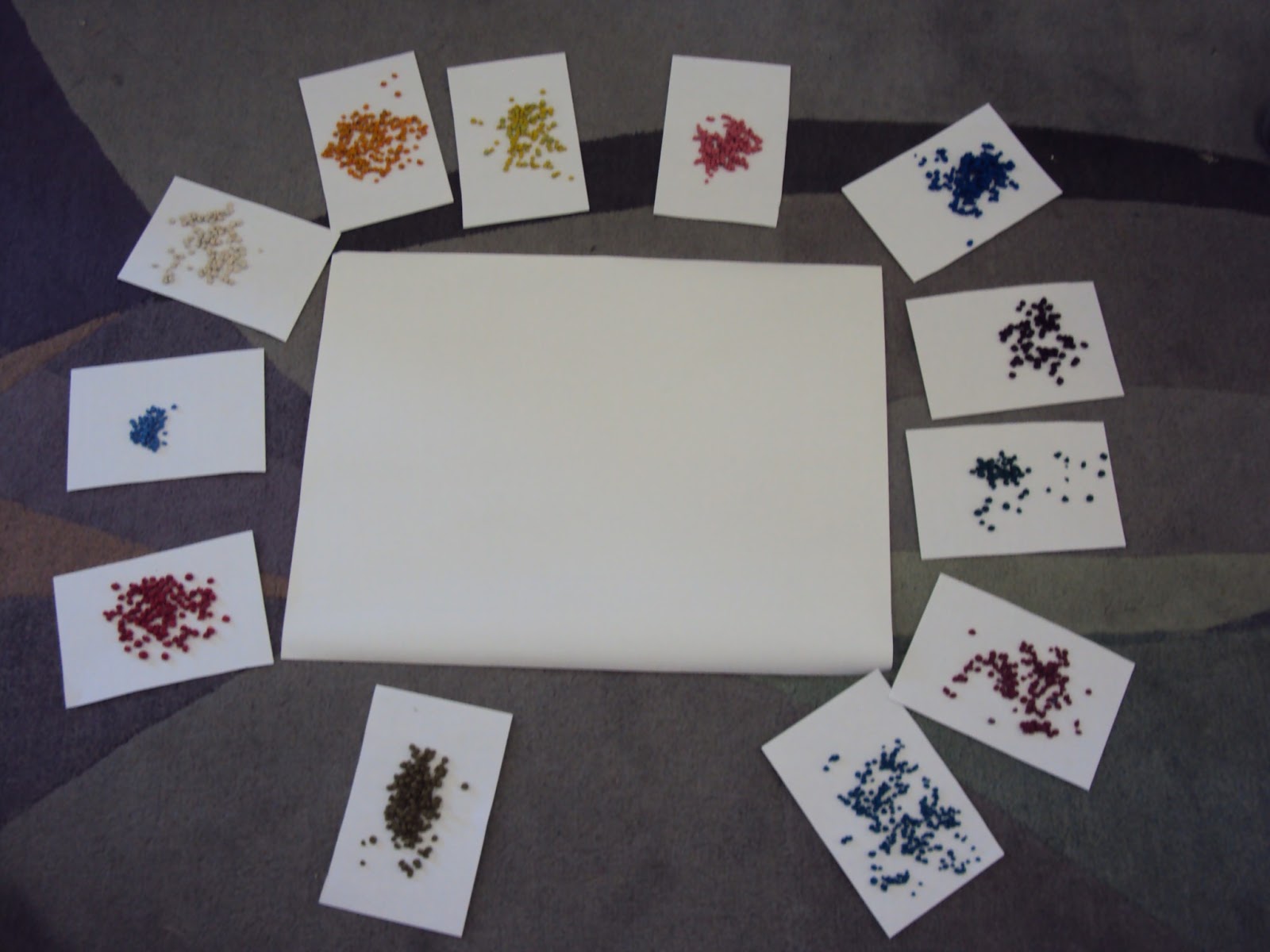 |
| The initial set up-- just before we decided to slow down. |
The children have been developing cultures for their people.
They thought of so many different things that could influence a group of people and their values and traditions.
- Language
- Values
- Likes/dislikes
- Talents of the country
- Celebrations
- Resources*
- Pollution Rate*
- Hemisphere
- Climate temperature*
- Water level*
- Water purity*
- Technology/modernization*
- Type of ruler*
- Ruler's Disposition*
- Traditional Food
- Music
- Legends
- Vulnerabilities*
*= were drawn at random out of a bag
 |
| Our current map. A roll of the die determined the number of squares a country would inhabit. How would the land size and the population work together to form the culture? Placement on the map was determined by the hemisphere and the temperature of the country's climate. Hot countries were placed near the equator and cold countries were placed near the poles. |
We are trying to determine how to proceed. How will we take turns? How many people will immigrate? How will the cultures mix? How do we keep track of the changing cultures?
We shall see what the future holds...
Looking Through The Lens: Habits of Mind
 |
| We revisited the Science Handbook that we wrote earlier in the year, but this time we looked through the lens of the Habits of Mind |
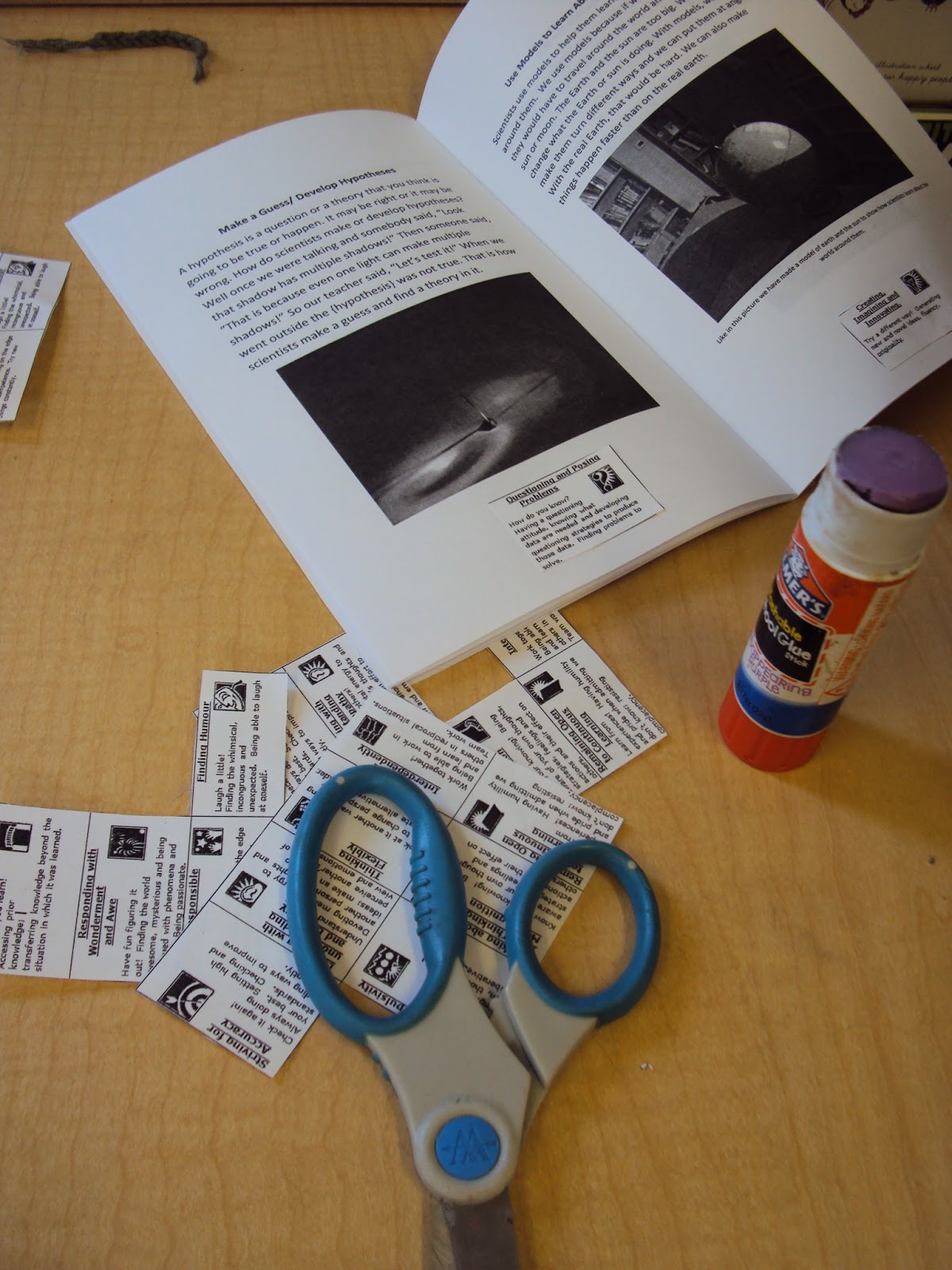 |
| We found the most of the sections in our book matched at least one Habit of Mind. It was exciting to see that the characteristics of successful people were so closely related to the skills the children identified themselves doing as successful scientists researching shadows. |
 |
| While the children learned a great deal about shadows, there will always be more to know. These habits are the learning that lasts. It is the learning that will carry them forward through their next challenges. |
Our Guidebook Section Correlating Habit of Mind
* Using our sense to observe *Gathering data through all of the senses
*Making connections *Applying past knowledge to new situations
*Try, try again *Persistence
*Be willing to change your mind * Remaining open to continuous Learning
based on what you observe
*Think outside the box *Creating, imagining and innovating
Tuesday, April 30, 2013
Community Sculpture

During the
first few weeks of school, we set the intention of creating a sculpture that
would hang right inside our door. It would serve as a reminder of the type of
community we are working to be. We just recently finished it, months later (it is a bit hard to photograph).
Working on it slowly over time helped us to revisit the ideas each week. Each
of the items was carefully chosen to represent a characteristic that is vital
to a supportive community. Here are the children’s thoughts on some of the
symbols.


“The
trophy means everyone is special because we could all get a trophy for
something.”
“Mammoths
protect their young. It reminds us to protect each other.”
“The
sun is happy.”
“The
moon is calm.”
“The Cloud
Dragon drops rain on fire. The fire represents rage or revenge. The dragon is a
peacemaker.”
“The
sword means protect someone in need.”
“Bees
work together to make honey. The beehive
means work together.”
“The
ladder is climbing up to the peace sign. It means that we need to keep striving
for peace.”
“Peregrine
falcons are clever, fast and work together. A big group of people working
together gets the job done fast.”
“The
skull reminds us that the Native Americans used every part of an animal’s body.
We need to use our resources well and not waste things.”
Friday, April 26, 2013
Forest Data
 |
| We've worked hard all year to observe the creek and collect data. The time has come to start representing. |
 |
| The experience is helping provide valuable lessons as the children think about what is going well and what they wish they had considered along the way. "I have the same date twice on my page! I don't know which one is right." "I have 1 degree on here and I know that cannot be right." "I lost my recordings for a few weeks." These are the lessons that young scientists can only truly learn from experiencing it. Adults can remind the children a thousand times to bring a certain tool or keep track of data, but the children only begin to care from an authentic place of wishing they had _________." Soon we will look at all of our data so see what we notice. |
We had visitors tour our school last week as part of our Personal Pathways and Paradigms institute here at Sabot. As the guests toured, we worked to answer the question "How has America's story of immigration impacted you and helped make you who you are?" Here are a few peeks at the children's thinking and representations.

These cups
represent a happy life full of good things and a life full of darkness and
struggle. The child who made this said that at first they thought their life was like the dark cup. As they started hearing the stories of immigrants,
they realized there was more good in their own life than the child had realized. Hearing the
struggles of generations of the past, gave the child a new lens for their own life and
challenge. It has helped to reframe the child's own experiences.
“When I
studied immigration I realized that we are lucky to have what we have because
there are people who don’t have what we have.”


"This ball of
wire represents a person who is an immigrant.
The purple
gem inside is their heart full of a desire to start a new generation.
The
propeller represents determination.
The wooden
tubes with colors shooting out represent flairs. They symbolize happiness when they finally make it to America.
The dark veil is like darkness and fright. It covers the whole journey.
The green glass piece at the end is the new generation that came out of this journey."
Did our ancestors think of us
during their journeys?
Did past ancestors think of
future generations?
Friday, April 12, 2013
Shadow Book
ShadowBookMovie from Andrea Pierotti on Vimeo.
While preparing for our school institute next week, I made our class shadow book into a video format for presenting purposes. This format makes it easier to share on the blog, too. I though some of you might like to see it in more detail.
Inspired by A Drop of Water by Walter Wick, this third grade class created beautiful photographs to communicate the simple but profound things they learned about shadows during their science investigation. The pictures and words were designed to share their learning as simply as possible. They prove that there is a lot more to know about shadows than one might initially think.
Photos and words by the 3rd Grade Children
Processing Through Symbols
We've been experimenting with using symbols to help process our reading. In our book groups, we read a chapter at a time and then work to develop a symbol that represents the essence of the character's experience in that chapter. I'm finding the needing to create a symbol brings new discussion to the groups. They talk longer and in more depth than they did before we started recording our thinking in this way. Here are a few examples from our reading today.

Ginny had tried for so long before this. What was it that had finally connected the girls? This is a symbol the children created. They realized that sharing the secrets was what welded Ginny and Stephanie together.

In the book Lily's Crossing, Lily is going through a lot of challenges. Her father went to war, her best friend moved, she has developed a habit of telling little white lies to get attention. In the chapter the children read today, Lily was processing all of her difficult feelings.
This is the symbol some of them created. It is Lily pulling a wagon full of heavy boxes. The boxes represent all of the emotional situation in her life. Up to this point, Lily was managing to pull the wagon. In this chapter, the wagon stops suddenly and all of the boxes come tumbling down. Lily can ignore them no longer and must face her emotions.

In Drita My Homegirl, Maxie is dealing with the loss of her mother to a car accident. Her dad is finally ready to start dating again which stirs up all kinds of emotions within Maxie.
The symbols created by the group are a volcano to represent when Maxie was letting her emotions out in harmful ways by being mean, fighting with her family, being rude to her dad's girlfriend and repeatedly getting into trouble at school.
In a later chapter, Maxie is finally ready to be honest with her father. They have an important conversation about all that they are both feeling. The children represented this chapter with a calm waterfall to show that Maxie is now releasing her emotions in a productive and less harmful way.
Using symbols to represent our reading is something I'm going to stick with. The level of sophistication and collaboration I've seen and heard is deepening. The children sketch and talk and suggest modifications they feel would more accurately portray the emotional journey of their characters. They are also more eager to participate in the group conversations because they are proud of their symbols and anxious to tell others about their representations. Yay!!!
Friday, April 5, 2013
Parent Night
Parents visited the classroom this past Wednesday. We talked about thinking symbolically and the power of the metaphor to facilitate higher level thinking. Then the parents got to do some of their own work.
"Think about the emotional journey of an immigrant, the journey of the heart. How can you represent all or part of the journey symbolically?"
The children came back to school the next day to discover the parents' creations. We spend time thinking and discussing the representations. Actually, we spend a whole hour looking at them and talking about them. It is more than one blog can manage, so here are a few.


Kali: They made green children because they were multi
cultural and they had two different cultures, not just one because if the
orange culture is its own culture and the blue culture is its own culture, then
they are technically making a new culture when you make it green.
Max: Then if even one orange person came over here, there could be hundred of green people because I more orange people come then maybe one of these orange people could marry another blue person. We Would end up getting a bunch of different cultures that you didn’t even have in the first place if just a few people didn’t immigrate. And it all started with just a few people immigrating here.

Cameron: The leaves, I like how she used the leaves because
if you are like on a sail boat trying to seek freedom …. when the leaves fall
from the tree, the wind could blow them away. Just like if a sail ship is
crossing the ocean for a certain destination, the wind could blow them away.
For example, the Mayflower was actually attempting to land in Jamestown.
Andrea: Sometimes you may end up where you weren’t
intending.
Henry: When a leaf falls, I think that means when one leaf
falls, leaves kind of spread. The first leaf starts all of the others. I think
that means that if only one or two people land in a place that no one else has
been before, they can make a whole settlement and make a civilization.


Henry: What happens if someone falls down the tree? It is like
climbing the tree to Ellis Island but when they get there, someone says, “No,
you can’t come!” so they fall back down the tree. I picture this never-ending
tree with tons of paths and ways and what I think he means by perspective is
that you can look down as past images of your life.
Aliza: I feel like once you get here [pointing to the three
colored paddles in the middle of the tree] you have to choose which path to
take.
Joe: When you get to the middle maybe you don’t have a job
but you have friends and you have a nice place to live. Even though you really
want a job, you still feel like you want to stay.
Andrea: You perspective changes along the way?
Mason: What happens when you get to the top of the tree? Do
you get back down?
Henry: I keep picturing a never ending tree, like it keeps
growing as you grow. I picture that the tree is your life… like your fortune or
something.


Rose: I think it is really interesting. I feel like the blue
panel is when they just see them, the red panel is when they are transitioning
and the yellow panel is like, “Hey we can see her clearer now!
Henry: I’m not sure if the panels have to go in order.
Everyone has a different perspective. Like what if someone sees them like this
[put the blue panel on] and someone else sees them like this [puts the red
panel on] and someone else sees them like this [puts the yellow panel on].
Andrea: So you are saying that rather than this person
having different panels throughout, the people looking have the different
panels? Someone sees everything with the red panel. Someone else looks through
the yellow…?
Kali: I was thinking that maybe the blue panel meant, “I
don’t really know this person.” The yellow means, “ Oh, we’re friends.” And the
red is like, “ I hate you!”
Andrea: So maybe the different panels represent different
emotions? Maybe one of them would be a prejudice.
Max: What I kind of thought was that you could have cross
panels. You could have purple [puts the red and blue together] . It gets really
dark. Then he almost becomes invisible to you. It is not going to help you, so you want to kind
of try to take the panel away from your eye. You want to tug it off.
Subscribe to:
Posts (Atom)