Friday, October 5, 2012

3rd Grade Economics

This past week a parent contacted me to let me know that children were making and planning to sell homemade posters and wooden toys at school for money. We admired the initiative of the children starting these businesses but felt uncomfortable with the exchange of money at school. Was there a way to keep the interest alive with an alternative like play money? I gathered the class for a discussion.

K: We could make play money.
M: But if just anyone can make the money then it is pointless. I has no value.
G: Maybe we could have a mint that makes the official kind of money like our government does.
M: It just seems too easy to copy.
Me: I have access to a copy machine and more unusual colors of paper up in the office. It is paper that isn't just in all of the classrooms.
K: You could use the money from math. It looks really official.
R: We could just pay in things like rocks and sticks like we did last year in the garden.
Me: I remember that. Is it going to be a problem that you are out on the field now? There aren't as many rocks and sticks out there.
M: That is even better because they will be more valuable.
H: If we use the money, how will it get out into the world?
F: We could just have a bank. You could go get money at the bank.
H: In the real world you don't just get free money.
Me: If I go to the bank to get money I would have already had to put that money in the bank earlier. They just hold it for me. Maybe you could all start earning it by doing extra jobs around school.
M: I would rather just trade natural resources. Rocks are much more valuable to me than fake money.
R: But if you do natural resources, what is the work you have to do for that?
H: You would have to go mine it out of the ground.
Me: Right, you spend your precious time and energy gathering those things and people are willing to trade or pay you for it because they don't want to spend their own time doing the work.

The conversation went on and on. The children thought about trading product for product. Or natural resource for resource. Could they set up a trading post? What jobs could they do? How would we make the money earning opportunities even?

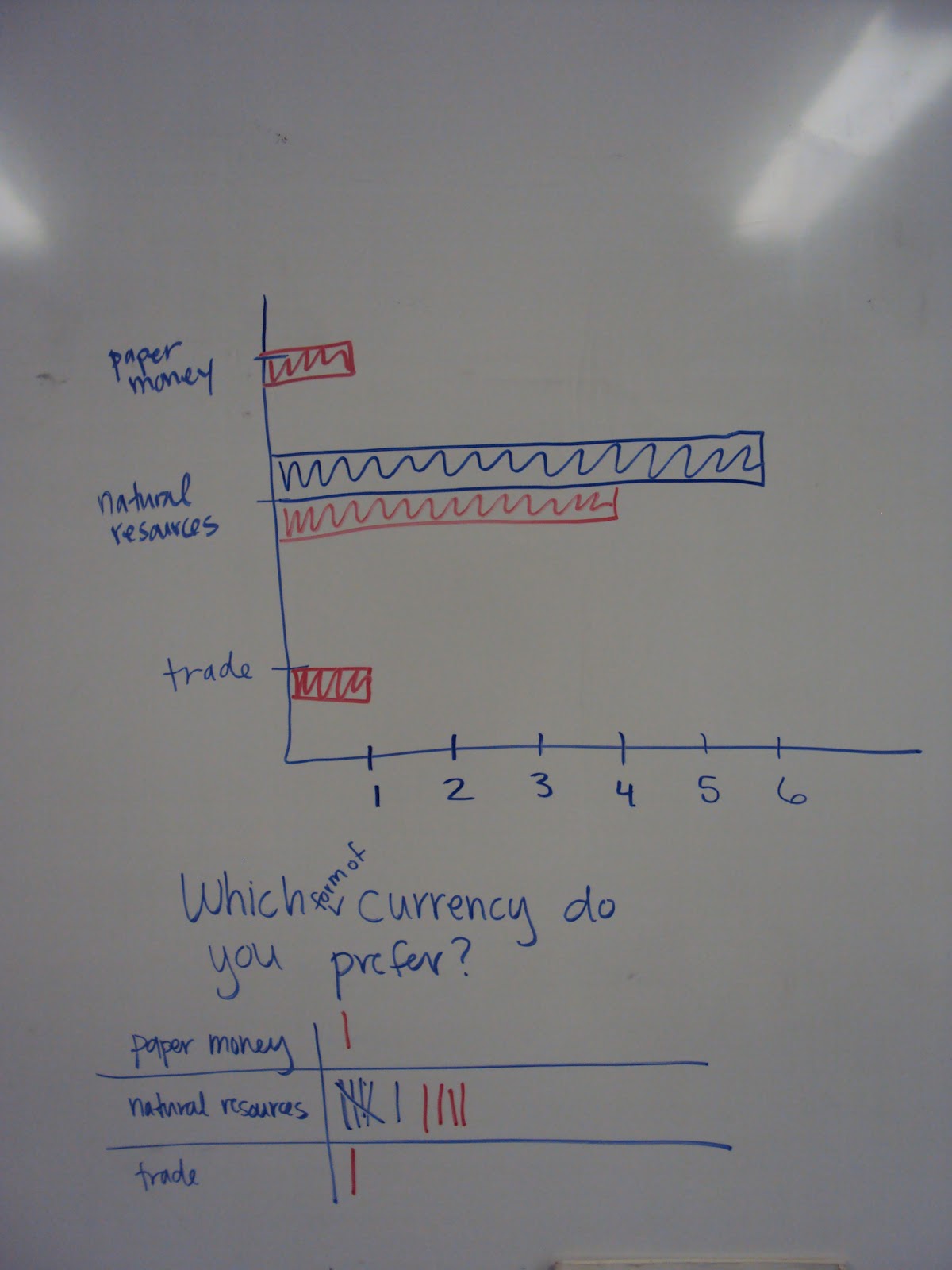
We voted on a currency. The children chose natural resources. One student asked, "I still like the idea of money, I just liked natural resources better. Can we just do all of them?" We decided no to limit ourselves to just one form of currency.

That very day during Spanish I got busy printing official money. By lunch the children were harvesting resources, making trades, forming business partnerships and making plans for their future fortunes.

A stick with more unusual characteristics may be more valuable.

Harvesting rocks to sell to rock smashers for money.

Money is kept in the watchful care of bankers while work is done during recess.

Smashing rocks makes them more valuable.

"Is crushed rock more valuable than a whole rock?"
"Yes, especially if you can get a piece that is just pure crystal."
The game allows us to substitute more authentic
questions into our math unit on data analysis.
Through out this process I am thankful to be in an environment where I have permission to slow down and give time to the things that are important to the children. Not an hour passes without me hearing whispered business plans. And never have the children so eager to pick up trash from the far corners of the playground. 

Monday, October 1, 2012

What's so special about vowels anyway?

In an effort to strengthen the children's foundational understanding of our written language, we have gone back to the basics. It lays the foundation for understanding syllables and how they work to form our words. Is there a way to construct this knowledge rather than try to take it on the teacher's authority. Spelling is not really my strength, anyway. I'm working on it, like they are, but I certainly don't qualify to be an authority on the subject.

"Why don't we call all of these (pointing to our letter cards) just letters of the alphabet? Why do we need the special names of 'vowel' and 'consonant'?"

No one seems to know. We start to think about it.

"Maybe because they all say two different sounds."
"What about c? It makes two different sounds but isn't a vowel."
"Every word has to have a vowel. I know that is a fact."
"Is that true? Can you think of any words that don't have a vowel?"

We sort through dictionaries and books in our room. We think of words like Mr. and Mrs. or Dr. but then we realize that they aren't really the word, they are abbreviations. What about hmmmm and shhhhh? Are those even really words or are they just sounds we make?

A child comes to school the next day with a word. "What about the word Rhythm?" It seems like maybe we found one.
"But it DOES have a vowel. The Y says /i/ like igloo so it is making a vowel sound," another child responds.

We repeat the discussion with nymph and sky.

To gain more information we say the sounds of each of the letters. We pay special attention to the shape of our mouths.
"What do you notice?"
"With the vowels my mouth was wide open."
"What about the consonants?"
"My mouth was a lot more closed."

We take some time to write what we are starting to notice:

  • It is like notes on a piano. Vowels sound like half notes because you hold them out longer. Consonants sound like staccato notes on the piano because it is one short little ding.
  • A vowel tells you how to open your mouth and a vowel tells you how to close your mouth. Your lips or your tongue touch.
  • A word without a vowel would be weird because your mouth would be closed all the time.
  • Without vowels words would not make sense. It would just sound like "ct".

Advice for Readers

Before we embark on a genre study or delve into thinking about character development in a story, we are spending our time getting to know ourselves as readers. We are trying to bring more meta cognition to our reading.
 
Can I tell when a book is easy, just right or too hard for me? How do I know?
 
As a teacher, I am wondering what role images can play in helping children understand advice for good readers. We recently discussed Lucy Calkins advice for reading "Faster, Longer, Stronger." Will creating images for each point of advice bring more understanding? Will the time it takes to translate the advice into images allow for more processing? Will the images stick with the children longer than the words alone?
So far I am noticing that when I reference the advice I can point the children back to the images. It instantly reorients them to our previous thinking with minimal amounts of discussion.
We've been focusing our attention on the image of fire and ice. It reminds us that in order to be a really good reader there are times when you speed up to read more quickly and times when we slow down and read more slowly. A good reader does both. Working to notice when we slow down is a form of self-monitoring.

When did you slow down during your reading today?
How did that make you a better reader?

The image of a towel soaking up water is a powerful instruction for how our hearts and minds need to  soak happiness, sadness, joy or suspense out of words. The thinking of a child brings more understanding to me as a learner, too.

Friday, September 21, 2012

Community Games

 Plans for games about good communities are underway.
 The children are working to develop games that can be played in class to
remind us of the type of strong community we would like to be.
 I am very interested in seeing these games develop.
What will they feel is important?
 How will this work help them to further process their ideas?

Whirlydoodle

 
One dark and windy morning this week, the children were able to see the lights on the Whirlydoodle windmill for the first time. During morning carpool the excitement was palpable. Children, who have since passed on to fourth grade, were also able to observe on the way to their classroom. It was a very exciting morning! Our ideas about energy are not dead and gone. They remain very alive in our windmill collection we have chosen to leave up.

Appreciation


We started a tradition today. Each Friday we will begin our day with sharing an "appreciation" for one of our class members. We are trying to think beyond our immediate friendships to people we might not usually get a chance to compliment. We are looking for acts during the week that help our class to be a better community. My intention for this tradition is to help us notice the kind things that happen in class. I also think that it is a time that we see our ideas and values in action in the small acts of each day.

"I appreciate you because you gave me lost of good feedback on my ideas."

"He always helps clean up."

"He apologized after he the soccer ball he kicked hit me in the face."

"You are great at listening at circle. You raise your and and listen quietly when others are talking."

"I appreciate that he apologized to the whole class after his silly day on Wednesday."

"I like how he always makes peace and doesn't want to fight."

"I appreciate that he always gives people comments and that helps other people give other people comments and it makes our class a better place to be."

"She contributes helpful ideas to our class."

"You help our community stay on topic."

"You do a great job at paying attention and for that I say thank you!"

Monday, September 17, 2012

Forest Fridays

Young scientists make observations that help define earth.
They observe a toad as if it is the fist time they have seen one.

Recess in the forest allows plenty of time to play in the stream.
We spend Friday afternoon in the forest. We go directly after lunch for recess and then stay for some work. Recently we used the time to think about metaphors for community.

A good community is like....
  • ants
  • bees
  • dolphins
  • trees
  • rain
  • water
  • the whole world fits together in a community
  • leaves
  • human body
As I looked over their analogies I noticed the majority of their answers were something found in nature. It was not surprising. We had done our thinking in the woods, after all. But I also couldn't ignore how an understanding of the natural world brings insight. It reminded me of the value of time in the wild to touch and smell and feel all of the experiences we can then connect to other ideas.

"Rain is like a community because each drop is like the little individual. We all come together to form streams and rivers. When water drops are together they can accomplish a lot of important jobs like cleaning things, watering plants and for drinking. The group of water drops can do a lot of good."

Educating the Heart

Of all of the things education brings to children, which is the most important? What one thing can we give them that will prepare them best for a successful, productive, happy life?

I've been thinking a lot about these questions as we begin a new school year as a way to help me center my work. Mary, Anna and I traveled to Portland, Oregon this summer to attend a conference at Opal School. I noticed their dedicated, almost obsessive, focus on community. They took it a lot further than I ever had. In fact, I thought maybe they took it too far. It was in everything! Science and community, history and community, community, community, community. Did it leave enough room for the "important" stuff?

In the past I've viewed work on "how we treat each other in class" as a way to oil the classroom machine. Sure, I thought we should all be nice and caring but it was a foundation so that things would run smoothly so that we would have time for all of the "real" curriculum and so that we could all exist in the same space day in and day out.

The overarching theme for our school (preschool-8th grade) this year is Relationship. This decision has caused me to think the topic over more carefully. The more I processed what I saw at Opal and the more I talked it all over with Anna and Mary, the more I decided to explore.

For the past three weeks of school our literacy and project work has centered around the exploration of community. How do we want to feel in our class? How do we act when we are together? What role does the individual play in a group?

I sat down to watch a movie tonight. One had recently caught my eye on Netflix.  It was called Happy.

http://www.thehappymovie.com/ "Happy takes viewers on a journey from the swamps of Louisiana to the slums of Kolkata in search of what really makes people happy. Combining real-life stories and scientific interviews, the film explores the secrets behind our most valued emotion. "

What the science of happiness says is that we need to be teaching children care and compassion. Happiness is linked to close connections to friends and family and compassion towards others. One of the things scientists have discovered is most effective in improving one's happiness is to practice acts of kindness. The act of kindness releases a chemical called dopamine, the happy chemical, into the brain. The dopamine released in one's brain as a result of kindness is as strong as a mood altering drug like cocaine! It was interesting to be reminded that we have a great deal of control over our own happiness.

The findings are not necessarily shocking. It seems rather intuitive. This type of wisdom has been around for a long time. I just wondered if it has been around so long that we overlook it. Do we forget just how powerful it can be? And if it is so key to happiness, where does it exist in education? Does it belong in education? Is happiness in life a goal of education?  Do happier children learn better?

Can we really disconnect the brain and the heart?

I am curious to see where this year takes us. What changes will I see in the children? How will this year compare to years past? What impact will I see as a result of so much focus on relationship and community?

I have a feeling that at the end of this year I will be a changed teacher. In the end, will I feel like we spent too much time on the topic of relationship? I have a feeling that the opposite will be true; the more we explore the ideas of community, the more complex and valuable we will come to find this work. Our attention will feel insufficient for a topic so powerful.


Wednesday, September 5, 2012

Who am I?

Who are you?
You are a small piece of the community, but a very important piece.
What strengths do you bring?
What talents will you contribute?
"Why do your eyes look like that?"
"Because I am quiet but I am always watching."
 

"My mask has a cloud dragon putting out fire with rain.
It is from the Japanese ledgend.
 It means I am a peace maker."

"Girls can be tough."

Wednesday, August 29, 2012

First Day of School

Thinking with blocks about the differences between a good community and a bad community
Ask you child about their creation.


 I need to learn how to better capture lighttable work. Any advice?
 

Wednesday, August 15, 2012

Looking Back

I ran across old class videos while preparing to share at a new teacher training. It was fun to revisit the old project videos several years later. It made me reflective.

Watching our old videos was kind of like reading an old middle school diary. It gets tempting to rip all of the pages out for fear of the flaws. It is hard to put it all out there for the world to see because it leaves me feeling so exposed. The warts often stick out the most to me as I review past work, but there is also a lot of beauty. I eventually have to face the fact that if I get rid of the things I get self-concious about then I also have to get rid of all of the beautiful, magical things that are intertwined and not able to be separated.

It is what it is.

It is a record of where I have been on this journey. There were moments when revisiting the videos helped me appreciate how far I've come in my understanding of this work. It was like a glance back at the trail I've climbed as I continue to work my way to the summit. However, I was also surprised to find that these videos were full of reminders of important things that I want to get back to.

Dear readers, I bring your attention to the risk one feels when sharing their work so openly and I hope that you will read this blog with compassion rather than judgement. But then again I probably don't need to worry because I've just survived the harshest judgement-- my own.


I've always loved this collaborative piece. Both the photos and the poetry are from the children.

Wednesday, May 30, 2012

You know you're at Sabot when....

... the children ask me to call them gods and goddesses instead of boys and girls. Or they wanted me to remind them to take their nectar bottles to P.E. or have ambrosia instead of snack.

 We recently had field day where our class took Greece as our country for an Olympic themed event. Realizing that there were twelve Olympians sitting on the thrones of Mount Olympus, the children decided that each should choose a god or goddess to be on the big day. In preparation, we took the characters on for weeks in advance. The children would play god and goddesses at recess, often incorporating bits and pieces of myths into the story lines they were acting out. I even convinced our math specialist to announce gods and goddesses names as a joke when calling children to the office.

Along the way I was telling this to another teacher who made a comment along the lines of, "Isn't it nice that these children can go to school where it is still cool to play gods and goddesses at recess? When my kids were in third grade it was anything but cool." By golly, I think she was right. The day before field day I was invited to be Hermes (since none of the girls wanted to be a god and we really needed all twelve represented).

It was magical! I have to admit that it has always been a bit hard for me to keep all of the characters and stories straight and it's all seemed a bit confusing, but something about cheering for Aphrodite while she did the egg race or chanting Apollo's name as he threw a water balloon shot put into the air really helped me to start making sense of it. These names started to come to life as I connected them to people I already had relationships with. Maybe there is something to playing god and goddesses. Maybe there is something to playing in general. The magic doesn't stop in their grade or shouldn't, anyway. If we let ourselves, I think this could be useful in middle school and as an adult. I just wished that I had joined the fun earlier.


How I Work

I am thankful to have the freedom and permission to let children work in the ways that work best for their brains. One child made a great discovery today...


He said,"I am doing the story of The Three Little Pigs and the Big Bad Wolf but I am switching it up with the story of The Three Big Elephants and the Little Bad Mouse. This is how I would plan it. I would act it out with blocks to make sure I knew what was going to happen, what the elephants are going to do to the mouse. This would now help me to focus. If I was going to write a fairytale, I would plan it out with blocks."

With a few coins in your pocket... (continued)

Here is the work introduced in my previous post titled "With a few coins in your pocket..."
I included the work of all of the children so look through as you would like. Again, this work was not made to show all of their solidified ideas about how immigration changed America, but rather it was through this process that they did some of their best thinking.


I am a Greek jewelry maker and I came to America because I wasn’t getting enough money in Greece. I made earrings with one of them having a z hanging from it and one with an omega hanging from it. The z is the last letter of the English alphabet and the omega is the last letter of the Greek alphabet. I did one z and one omega
because the Omega is for living in Greece and the z is for coming to America. In America I am getting more money because the earrings are a new style and people think they are interesting so they buy them and I get more money. Now American jewelry has a Greek influence.

 I am in the shoes of my father who immigrated to America. I want to fly on a concord so I created a model concord. I am going to America to seek education so I drew a computer on the side of the toy concord and wrote “Concord for Learners” on it. I will emigrate from the U.K. so I wrote U.K. Airways on it.

When I get to America, I will be a model maker. Inspired by my dad’s story, I will make model Concords. This is one of my models.


I made this because I emigrated from Greece and I needed to find a job in America. I decided that, as a blacksmith, I would make a lyre from my own home and everybody else would see what music was like back in Greece. I decided to bring the music with me to the new land. I would make these and sell these and everyone else would start liking them so other blacksmiths would start making them.


I needed a job in America. I thought of something an American might be interested in. Then I realized, I just simply had to show my old home. It would be so interesting to them. I mean who had ever seen stinging nettles? They would find it fascinating. And they had never seen the English flag so that would be pretty cool for them. It is going to be hard to find a job. But on the other hand, I will be able to fascinate people with my sewing.


I am from Russia. I made a toy boat to remind me of my trip from Russia to America. Back in Russia I was a sailor and in America I am a sailor too. I am bringing a toy boat to America to show America something new.


I am a German boat maker who makes large boats. I am also an air plane maker. I could help design a boat and then travel over to America on it, just like the designer of the Titanic. Once I get to America I could design more boats and help people get to other places on boats and airplanes. I would teach American about ways that boats work so they might want to use my ideas. This is how I would not be poor but still have a business going on in a new land.


I am a blacksmith from Ireland. I make horseshoes. I made a horse and I would bring that horse on the ship with me so that I can travel to places faster in America. When I got to America, I became a teacher and taught people how to make horse shoes. That is how I made money in America.


I am a chocolate maker from Germany. I came to America because I wanted to escape World War I. I came on a ship and I felt very alone in the world because I was one of the only people from Germany. I felt cold, sad and sort of worried that I wouldn’t make it. I think the chocolate making from Germany will help me get money and get a good job.


I am a Chinese toy maker. I came to America with my family to have a better life. I made a ship and life boats and my family to represent how I came to America. By me coming to America I will change it because there might not be certain types of toys that are like the Chinese versions.


I came to America as a food maker. I decided to make lasagna to show how I immigrated with the cheese shaped like my voyage on top. People probably haven’t had lasagna so I cold make a really good shop after I start out on the streets and such.


I am a living room designer from France. I came to America because I wanted to escape slavery. I needed to get money so I decided that a living room designer would get me money because I did the living room designs back in France and those people liked them. Now in America their living rooms have a part of France. They have French influence.

I am a mirror maker from Germany. I came to America because I wanted to have a better business because people didn’t want mirrors in Germany. I thought that since lots of people came from different places that they might want to see or try out a mirror from Germany to see what it is like. It will give a new variety of mirror to America. My talent might get more used than back in Germany.


Tuesday, May 29, 2012

Slowing Down

 "If they had never come we wouldn’t be here."


                         "...each one brings one piece of America."

 "If other people come to America then it actually changes America and America changes them."

"... without all of these people coming, America would be tiny and boring. There wouldn’t be certain foods, any cool designs of houses, it just wouldn’t be right without these people coming."