Friday, March 22, 2013
They're Coming to America
We were inspired by a great poet this week. He wrote a moving poem about immigration, maybe you know it. Here are our class notes so far about Neil Diamond's poem "America". It inspired our own poetry writing (and maybe a spontaneous dance party or two, once I told them it was also a song).
Researching as Historical Authors
We've been researching. It is always easier with a lens. We've been wondering if the adventures of history could become the inspiration for fictional stories. Can we write historical fiction about our heritage of immigration? We currently look at many things through that lens.
A father, who immigrated from Honk Kong, came to visit us this week. He shared his story. We took time afterwards to compile a list of things from his experience that we could give to a character in a story we may write in the future.
We read an article about Ellis Island and took notes about experiences those passing through Ellis Island faced. Which experience might we give to our characters? We learned what steerage meant and what conditions might be like for passengers traveling in steerage. We know that they used phrases like "The Island of Hope" and watched carefully for the Statue of Liberty. Our characters probably will, too.
A father, who immigrated from Honk Kong, came to visit us this week. He shared his story. We took time afterwards to compile a list of things from his experience that we could give to a character in a story we may write in the future.
- He went to a party and didn't know what a taco was or how to eat it. Tacos seems exotic. He bites the middle and it falls apart. He watches everyone else to learn how to eat a taco. What exotic things will our characters encounter?
- Missing the fresh food from home and not liking the American stuff from the market (open a box, open a bag, put it in the microwave). What about America might make our character miss home?
- Liking how big and open America feels, the fresh air, the high standard of living and it does not feel crowded. What might be different from home in a good way?
- He keep some holidays from his old culture and also starts celebrating some from the new. What might our characters keep from their old culture and what might they acquire from their new culture?
We read an article about Ellis Island and took notes about experiences those passing through Ellis Island faced. Which experience might we give to our characters? We learned what steerage meant and what conditions might be like for passengers traveling in steerage. We know that they used phrases like "The Island of Hope" and watched carefully for the Statue of Liberty. Our characters probably will, too.
Thursday, March 7, 2013
Aliens Among Us
When we started to think about immigration, we realized that we knew people from other countries. In fact, we counted at least six who work right here on campus. We wrote to invite them to class. We've been listening to their stories for the past few weeks. They've talked about their motivations for coming to America, what they felt as they left home, confusing situations they found themselves in and what tokens they brought to remember home.
Meanwhile, we have also been considering under what circumstances we would be willing to leave our home forever. So far we have about 22 reasons that are compelling enough to the children. Interestingly enough, many of them are the situations our ancestors faced when deciding to immigrate.
Wednesday, February 27, 2013
MLK Day Lives On
Life's most persistent and urgent question is, 'What
are you doing for others?'
Martin Luther
King
![]() |
| At the food pantry |
![]() |
| Getting organized |
![]() |
| Filling bags |
When we got back to school, we made posters that added to the message from Dr. King.
What advice did the children have?
"Helping makes everyone happy. When you help, you feel good too."
"Everybody is human."
"It is hard to be happy without being kind."
Monday, February 25, 2013
How to be a Scientist
"How do scientist learn about the world around them?" The third grade wrote this guidebook to share their insights on the process of learning like a scientist. The content is completely from the children. They developed the headings and the explanations. It is a bit long, but even just by scanning through the headings, one can see the depth of understanding the children are developing about how to think like a scientist. In the end, my goal was not for them to learn everything there is to know about shadows (however, they did learn a lot). In the end, I wanted them to learn how to learn.
How to be a
Scientist
Written by 3rd
Grade
2012-2013
Sabot at Stony Point
How Scientists Use
Their Senses
Scientists use their senses to observe the world around
them. Astronomers use sight for stargazing. Chemists use taste if their
designing a food.
As scientists, we used these same skills. We used our sense
of smell to observe this liquid. We used touch to feel this charcoal. We used
sight to observe shadows.
Observe Over A Period
Of Time
Every Friday our class goes into the forest to observe the
creek. Observing over a period of time is important because if you just look at
something once, then you don’t have believable data. We record our data in the
class binder so that we can compare it to the other days we measure. We see if
it is similar or different.
Making Connections
Making connections is an important part of science. Making a
connection is very simple. You just have to relate one thing that happened to
you in the past to something that is happening in the present. You also have to
use your brain to figure things out. For example, when we were studying
shadows, we related a flashlight to the sun because we were holding it up like
it was the sun. We used what we learned from this model to connect and learn
more about the sun.
Scientists Do Things
More Than Once
Scientists check something more than once because they want
to be accurate. For example: Let’s say that you are measuring the depth of the
creek and you measure it once and you get 17 cm. You went back again and got 15 cm. The reason
that is, is because the creek is not always going to be the same measurement
because the creek always changes.
Scientists also do things more than once because you want to
make sure you are accurate. For example, when I go down to the creek, I always
measure in different places to find the deepest place. If I just measured once,
it would be like the creek was always one depth.
Try, Try Again
Scientists try, try again to prove theories. If their
theories aren’t right they try again. For example, when we were studying
shadows, we kept trying to see if shadows disappeared at noon. We went out
every day at noon to see what happened. Our answer was that they do not disappear.
People had to change their mind about what they thought.
Measure
Measuring is very important in science for tests and
experiments. Measuring is important because you use it in different varieties
of science and without measuring it would be hard to get believable results.
With measuring, it is easier to compare.
|
The depth group is
measuring the depth of the water in the creek.
|
Be Willing to Change Your Mind Based on What You Observe
When you are doing and experiment and you have a hypothesis,
maybe you have a different hypothesis than other people and then you do a test
and you find out that your theory is wrong you should be willing to change your
mind for example: when our class had a theory that shadows disappear at noon.
We went to experiment and some people were wrong. They were willing to change
their mind based on what they observed.
Learn From Your Mistakes
Sometimes people have a different hypothesis than others and
they go outside and realize they're wrong but then, all of the sudden, the person
realizes that he learned something from his mistake. Example: When a person in
our class had a hypothesis of a single light causing multiple shadows but then
we tested and his theory was wrong but we learned that a single light causes a
single shadow.
Make a Guess/ Develop Hypotheses
A hypothesis is a question or a theory that you think is
going to be true or happen. It may be right or it may be wrong. How do
scientists make or develop hypotheses? Well once we were talking and somebody
said, “Look that shadow has multiple shadows!” Then someone said, “That is
because even one light can make multiple shadows!” So our teacher said, “Let’s
test it!” When we went outside the {hypothesis} was not true. That is how
scientists make a guess and find a theory in it.
Use Models to Learn About Other Things
Scientists use models
to help them learn about the world around them. We use models because if we don’t use models
they would have to travel around the world and possibly to the sun or moon. The
Earth and the sun are too big. We can’t change what the Earth or sun is doing.
With models, we can make them turn different ways and we can put them at
angles. With the real Earth, that would be hard. We can also make things happen
faster than on the real earth.
|
In this picture
we have made a model of earth and the sun to show
how scientists learn about
the world around them.
|
Think Outside the Box
Scientists think outside of the box because it is useful.
Thinking outside the box is when you just don’t think normally. For example,
that is how multiplication was invented. Thinking outside the box is a wacky
form of creativity. You can come up with new ideas.
Consistency
Be consistent. Don’t change what you are doing. For example,
we measure water temperature, water depth and pH each Friday in the same way
using the same instruments. If you were not consistent, you would not get
correct measurements and probably get untrustworthy results.
Record Your Results
Recording is very important because if you don’t you might
forget your measurement and think it is something else. Like when one of the 3rd
grade students who was in the depth group was measuring and she forgot it so
she made and estimate of a higher water level.
Don’t Rush
Don’t rush it doesn’t help at all, you might get the wrong
measurement if you rush your experiment. Like when a girl in the temperature
group she just stuck the thermometer in the ground and took it out soon after.
Later they learned that it takes about 4 minutes to change to the correct temperature.
Don’t Jump to Conclusions
Check multiple times until you are certain. Don’t jump to
conclusions. Voting is not a conclusion. Experimenting to find out is a more
reliable conclusion. For example, if a scientist were to jump to conclusions,
they might not be correct and that would throw the whole experiment off.
Thursday, February 21, 2013
Noon Shadows
Noon Shadows from Andrea Pierotti on Vimeo.
I was looking through some old video footage from our shadow investigation. The work went on over a few months. We had many conversations, observed outside day after day, built models, and used an indoor light labratory to try to answer the question, "Do shadows disappear at noon?" Enjoy a small glimps into the process.
Monday, February 18, 2013
Integration
I am excited for the next few months. Reading, writing,
history, math and our focus on community are all starting to collide. We are always
trying to integrate. We look for connections between all that we do, but this
time it is all coming together so seamlessly. Here is a little peek.
What types of challenges do the characters face in the books
we read?
How did the characters learn and change from these
challenges?
What can we learn about life from watching the journey of
our characters?
| We began to look for the conflicts that drove the story in all of the books we read. Every book containing a story has also contained a conflict of some kind. We keep adding to our chart. |
Where do authors get their ideas for the challenges they
give to their characters?
Challenges seem to get worse before they get better, so how
do authors build the tension of the challenge before it gets resolved?
| We researched the work of published authors. We read and mapped out the story of picture books on a "story mountain" to help us identify the story arch. |
Who will be our characters in the stories we write?
What
challenges will they face?
Are there challenges you have faced (or seen others face)
that you could give to your characters?
·
Scared of the dark
·
bullies
·
wanting to fit in
·
never getting to do things because you are the
youngest
·
not wanting a lot of attention
·
being scared to do something on your own
·
peer pressure
·
not wanting lots of attention
·
a brother who teases
·
always being late
·
not knowing how to write fiction
·
stage fright
·
words always coming out the wrong way
| As authors, the children began to plan out their own fictional writing on a story mountain. They gave careful thought to how the story would build over time before being resolved. |
How can listening to others for understanding and empathy
help us resolve conflicts within our own community?
| We have been thinking about these Habits of Mind. We have talked about persistence and controlling impulses. Our current focus is on listening to others with understanding and empathy. We are finding that it is a skill we can use to become better at just about everything (including math, reading and writing) |
How can listening to the characters for understanding and
empathy make us better readers?
"If I were Jessie, I would be feeling both excited and scared. I would be really scared and sad to leave without Grandmother, but this was a once in a lifetime opportunity."
How can listening to our fictional characters for
understanding and empathy help us figure out what to write when we get stuck?
How does listening to stories of the past for understanding
and empathy help us understand the people of the past?
| We are beginning to fill our time with historical fiction and non-fiction books about immigration. We read with empathy, imagining what it might feel like to be those characters. |
What was it like to immigrate to America? What challenges
did our ancestors face?
| We are beginning to hear stories of the ancestors of class members. There stories bring the past to life. This was not just some random person a long time ago, it was Cameron's ancestor! |
Could the challenges of the past be the inspiration for our
next fiction stories?
| We hear about how our ancestors traveled to America, why they chose to come and what their hopes were for future generations. |
Can our ancestors inspire our next characters?
Friday, February 1, 2013
Ellis "Treasure" Island
As part of our history investigation, the children have been looking at documents trying to find clues to unlock the mystery of this time in American history. They had noticed big patterns:
While the children were discussing their ideas about the historical scenario in question, one child said, "I wonder why they were traveling to Ellis Island. I mean why did they even care? Did Ellis Island have a treasure?"
Sometimes when I hear unexpected comments like this, my initial reaction (in my own mind, of course) is to kind of surprise. "Isn't that cute. They think there is treasure on Ellis Island." And then dismiss the idea all together because I know the travelers weren't hunting for burried pirate's treasure.
Over time, I've been practicing suspending judgement. I'm trying not to react to the idea and theories of children until I have a better understanding. In making an effort to listen, I have to pause and ask a follow up question. I'm not perfect at it yet, but more often than not I am completely blown away by the thinking behind some of the statements I initially do not understand.
"Tell me more about that."
"Well you know how the early settlers of Jamestown came because they thought there was gold? I wonder if these people thought there was some sort of treasure too and that it was buried on Ellis Island."
What a valid point. Hadn't there been rumors of gold influencing the settlers of Jamestown? Hadn't there been large migrations to the west coast because of the gold rush? Seeking treasure was a very real motivator throughout history.What I was tempted to view as a simple child's view of pirates and treasure was actually a profound connection to this child's previous knowledge of history. The class had spent their time as second graders completely immersed in the study of the early Virginian settlers of Jamestown. Come to think of it, weren't many of those immigrants in search of a treasure of sorts?
Not only did this child's idea make sense in context, it was a pretty brilliant idea. Yes, they were traveling to Ellis Island for treasure. The next question is what was that treasure.
Seeking the context of thoughts allows me to spot gems that I would have otherwise completely overlooked.
- People moving
- Sailing in ships across the Atlantic
- Steam ships
- Often going to Ellis Island
- Dates in the early 1900's
- Who were these people?
- Where were they going?
- Why were they traveling?
- Where is Ellis Island and what does it have to do with immigration?
- Why do these documents always talk about aliens?
While the children were discussing their ideas about the historical scenario in question, one child said, "I wonder why they were traveling to Ellis Island. I mean why did they even care? Did Ellis Island have a treasure?"
Sometimes when I hear unexpected comments like this, my initial reaction (in my own mind, of course) is to kind of surprise. "Isn't that cute. They think there is treasure on Ellis Island." And then dismiss the idea all together because I know the travelers weren't hunting for burried pirate's treasure.
Over time, I've been practicing suspending judgement. I'm trying not to react to the idea and theories of children until I have a better understanding. In making an effort to listen, I have to pause and ask a follow up question. I'm not perfect at it yet, but more often than not I am completely blown away by the thinking behind some of the statements I initially do not understand.
"Tell me more about that."
"Well you know how the early settlers of Jamestown came because they thought there was gold? I wonder if these people thought there was some sort of treasure too and that it was buried on Ellis Island."
What a valid point. Hadn't there been rumors of gold influencing the settlers of Jamestown? Hadn't there been large migrations to the west coast because of the gold rush? Seeking treasure was a very real motivator throughout history.What I was tempted to view as a simple child's view of pirates and treasure was actually a profound connection to this child's previous knowledge of history. The class had spent their time as second graders completely immersed in the study of the early Virginian settlers of Jamestown. Come to think of it, weren't many of those immigrants in search of a treasure of sorts?
Not only did this child's idea make sense in context, it was a pretty brilliant idea. Yes, they were traveling to Ellis Island for treasure. The next question is what was that treasure.
Seeking the context of thoughts allows me to spot gems that I would have otherwise completely overlooked.
Monday, January 28, 2013
Community Street: How to Help Edit
How To Help Edit from Andrea Pierotti on Vimeo.
This skit was developed and edited by these two third graders. This is their advice about how to edit in a supportive way. Stay tuned for more small episodes developed by the other children in the class. This is our work for an hour each Friday when we revisit the topic of being a caring community.
Wednesday, January 23, 2013
Forest Research
Forest Research from Andrea Pierotti on Vimeo.
Take a peek at our time in the forest on Fridays. I can already see them talking spontaneously about the changes they are observing. I'm excited for the representations of their data. Which things changed the most? Which did not change much at all? Why?
First Snowfall
Monday, January 21, 2013
MLK Day: A Day of Community Service
| Children from many grades kicking off our Togetherness Project with Anna in Founders Hall |
| Writing messages of togetherness. |
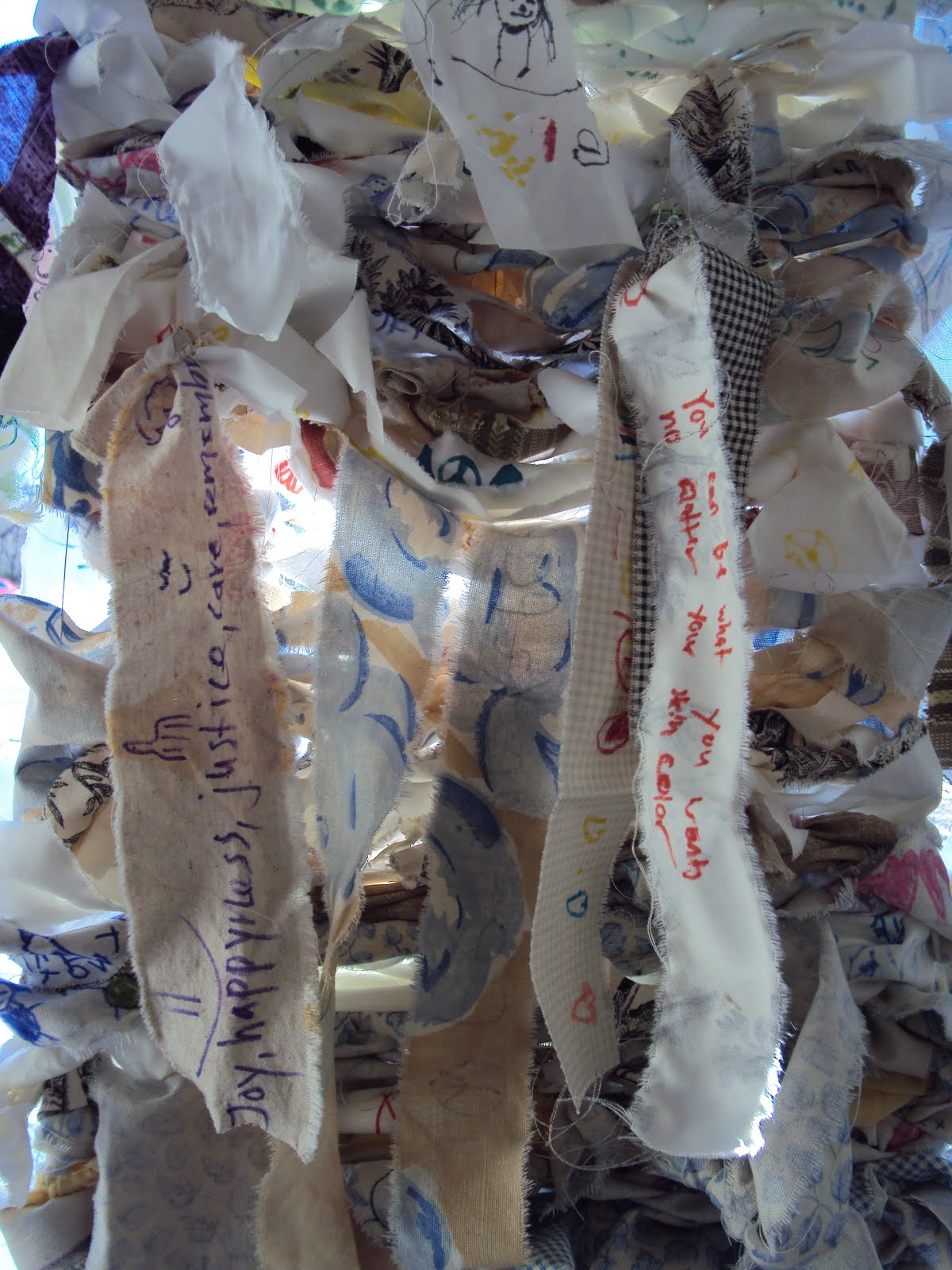
| Weaving the messages together as a symbol of our hopes for the future. |
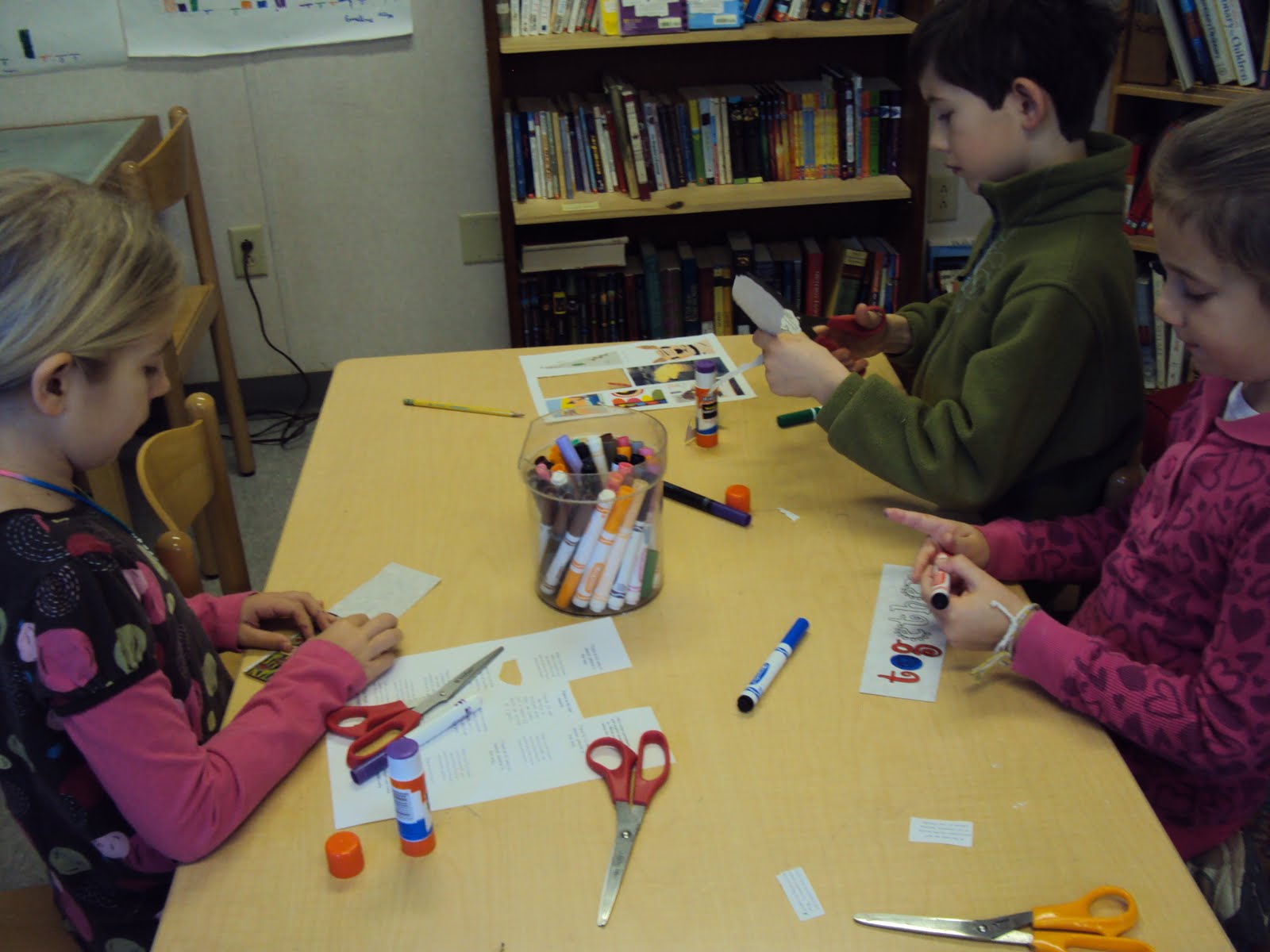
| Making bookmarks to accompany the books we donated to children in need. We filled our designs with messages of love and hope. Some people even used the words of Dr. King |
| Cooperative games with the 4th and 5th grade and Renee. We did a kindness project with 4th grade that involved some "guerrilla goodness." Check out the project here (you may find other fun ideas to spread kindness at home). We also snuck around campus leaving similar messages for the people around us to find. Sneaking around is fun! |
Subscribe to:
Posts (Atom)